
Why Choose a Graphite Clay Crucible for Metal Melting?

Choosing the right crucible can shape the entire metal melting process. A Graphite Clay Crucible combines graphite’s thermal conductivity with clay’s structural stability. This composition helps transfer heat evenly around the metal charge. It can also reduce temperature differences during controlled heating.

In practical foundry work, operators value crucibles that heat steadily and resist repeated thermal cycles. Graphite conducts heat efficiently, while the clay binder supports rigidity at elevated temperatures. This balance can improve melting consistency for materials such as aluminum, copper, brass, and selected precious-metal alloys. Performance still depends on crucible grade, furnace design, heating speed, and metal compatibility. No crucible is universal.

That matters. A reliable selection process begins with the alloy’s melting temperature and chemical behavior. The crucible should also match the furnace capacity and lifting equipment. Before use, experienced operators inspect the surface for cracks, deep erosion, or moisture. A small defect can worsen quickly during heating. Preheating is essential, but excessive heating can cause damage too. Manufacturer guidance should remain the primary reference.

A Graphite Clay Crucible may offer a practical balance between durability, heat response, and cost. However, real results depend on disciplined handling and accurate process control. Records from previous melts can reveal wear patterns and unexpected reactions. Even experienced users should question assumptions after each production cycle. That reflection supports safer, more repeatable melting operations.
Why Choose a Graphite Clay Crucible for Metal Melting?

What Is a Graphite Clay Crucible?

Why Choose a Graphite Clay Crucible for Metal Melting?

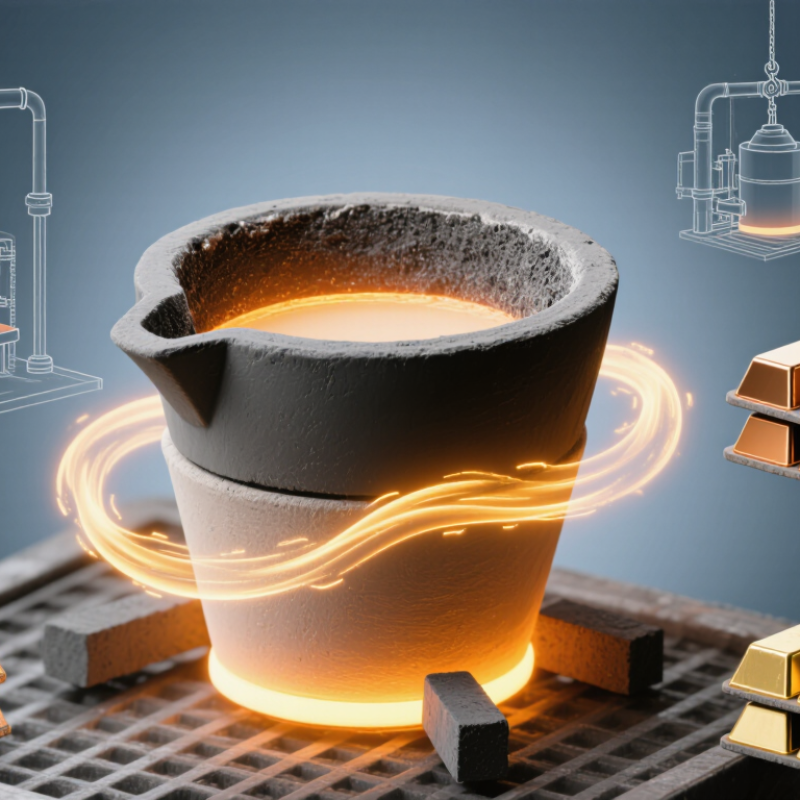
A graphite clay crucible is a heat-resistant vessel made from graphite and refractory clay. Graphite helps transfer heat evenly and withstand repeated heating. Clay adds structure and improves resistance to molten material. Together, these materials create a practical container for controlled metal melting.

In workshop use, the crucible sits inside a furnace or on a suitable heat source. Its dark surface absorbs heat quickly, while the clay matrix supports the shape during thermal cycling. This combination can reduce hot spots and help maintain a stable melt. It also resists many common molten metals, although compatibility depends on temperature, alloy, and furnace conditions. It is not indestructible. Sudden heating, trapped moisture, or rough handling can cause cracks. I have found that small surface changes deserve attention, even when the crucible still appears usable.

Tips: Dry the crucible completely before heating. Warm it gradually. Inspect the rim and base before every use. Use clean, dry tools. Avoid scraping the interior. Match the crucible size to the batch, because excessive empty space can waste heat. Always follow the furnace and material safety guidance. Ventilation matters. A crucible may look sound outside while weakening inside, so replace it when cracks, deep erosion, or unusual flaking appear.

How Graphite and Clay Properties Support Metal Melting

Graphite and clay work together to create a crucible suited to demanding metal melting. Graphite transfers heat quickly through the vessel, helping the charge warm more evenly. This can reduce cold spots during melting. Clay provides refractory structure and helps the crucible keep its shape at high temperatures. The combination feels practical, not magical. Material balance matters.

In furnace operation, a graphite clay crucible should be heated gradually before full use. Sudden heating can create thermal stress and hidden cracks. A dry crucible is essential. Moisture may expand rapidly and damage the vessel. Operators should also match crucible capacity with the metal charge. Overfilling increases spillage risks and can weaken the rim during handling. Small details matter.

Graphite offers useful chemical resistance, but it is not immune to oxidation. Extended exposure to air at high temperatures can consume the graphite surface. A suitable furnace atmosphere and correct heating practice can slow this damage. Clay content also affects thermal shock resistance, strength, and service life. More clay does not automatically mean better performance. That trade-off deserves attention. In practice, crucible condition should be checked before every melt, especially around the base, wall, and pouring lip. A crucible may look sound and still contain internal damage. Careful inspection remains more reliable than appearance alone.

Why Choose a Graphite Clay Crucible for Metal Melting? - How Graphite and Clay Properties Support Metal Melting

Performance Dimension Graphite Contribution Clay Contribution Practical Benefit in Metal Melting Typical Reference Data
Thermal Conductivity Graphite transfers heat quickly and distributes it relatively evenly across the crucible wall. Refractory clay and mineral phases provide a less conductive ceramic matrix that helps moderate heat flow. Faster and more uniform heating can help reduce localized hot spots during melting. Graphite: approximately 100–200 W/m·K at room temperature, depending on grade and orientation. Dense fireclay: commonly about 1–3 W/m·K.
Thermal Expansion Graphite generally has a low coefficient of thermal expansion, helping limit dimensional changes during heating. Fireclay and aluminosilicate phases add refractory stability to the composite structure. Lower expansion and a compatible composite structure can reduce thermal-stress risk during repeated heating and cooling. Graphite: commonly about 2–5 × 10⁻⁶ K−1. Fireclay-based ceramics: commonly about 4–6 × 10⁻⁶ K−1, depending on composition.
Thermal-Shock Resistance Low expansion and good thermal conductivity help graphite tolerate rapid temperature changes better than many dense ceramics. The clay matrix provides shape retention and refractory support around the graphite structure. Useful for batch melting operations where the crucible experiences repeated heat-up and cool-down cycles. Performance depends on wall thickness, porosity, moisture control, heating rate, and the specific graphite-to-clay ratio.
High-Temperature Capability Graphite can remain stable at very high temperatures in inert or reducing atmospheres; it does not melt at normal atmospheric pressure and sublimes at approximately 3,600 °C. Clay-based refractory phases provide structural stability, but their service limit is lower than the sublimation temperature of graphite. The usable temperature is governed by the composite formulation, atmosphere, glaze, and crucible design rather than graphite alone. Many graphite-clay crucibles are used for nonferrous and selected ferrous applications up to roughly 1,200–1,600 °C. Always follow the stated service limit for the specific formulation.
Oxidation Behavior Graphite gradually oxidizes in air at elevated temperature; oxidation becomes a significant design concern during prolonged exposure above approximately 500 °C. The ceramic matrix and protective surface treatment can reduce direct exposure of graphite to oxygen, but they cannot eliminate oxidation indefinitely. Protective glaze, controlled heating, suitable furnace atmosphere, and avoiding unnecessary high-temperature holding help extend service life. Graphite oxidation rate depends strongly on temperature, oxygen concentration, exposure time, porosity, and surface protection.
Wetting and Metal Release Graphite is generally non-wetting toward many nonferrous melts, which can help metal release after solidification. Clay and refractory mineral phases provide a chemically stable surface when properly fired and glazed. Reduced sticking can simplify pouring, cleaning, and metal recovery, although alloy chemistry and surface condition remain important. Compatibility is alloy-specific. Molten iron and some carbon-sensitive alloys may interact with graphite and can increase carbon pickup.
Electrical and Induction Heating Response Graphite is electrically conductive and can interact effectively with suitable induction-heating systems. Clay is electrically insulating and helps separate and stabilize the conductive graphite phase. The composite may provide a useful balance between induction response and refractory containment. Induction performance depends on graphite content, crucible geometry, wall thickness, frequency, coil design, and furnace power.
Mechanical Support Graphite provides a lightweight carbon framework with good high-temperature stability in the correct atmosphere. Clay and other refractory additives improve rigidity, shape retention, and resistance to deformation during handling and heating. The combination is stronger and more dimensionally stable than a loosely bonded graphite body under many operating conditions. Mechanical strength varies substantially with firing temperature, density, porosity, binder content, and wall design.
Typical Metal Melting Temperatures Graphite-clay crucibles are commonly selected for metals whose melting temperatures fall below the crucible’s rated operating temperature. A suitable operating margin is needed for superheating, pouring, heat loss, and temperature measurement uncertainty. Zinc: approximately 420 °C;
Aluminium: approximately 660 °C;
Brass: approximately 900–950 °C;
Copper: approximately 1,085 °C;
Cast iron: approximately 1,150–1,200 °C;
Carbon steel: approximately 1,370–1,530 °C.
Best-Fit Applications Supports efficient heat transfer and good melt release, especially for many nonferrous alloys. Supports refractory containment and structural durability during repeated melting cycles. A practical choice for aluminium, copper, brass, bronze, zinc, precious-metal, and selected ferrous-metal melting when the crucible rating and chemical compatibility are appropriate. Application suitability depends on alloy composition, furnace atmosphere, target temperature, holding time, crucible capacity, and pouring method.

Data note: Values are representative engineering ranges for graphite, fireclay, and graphite-clay refractory systems. Actual performance varies with raw materials, formulation, density, porosity, protective coating, furnace atmosphere, heating rate, and operating practice.

Which Metals Can Be Melted in a Graphite Clay Crucible?

Graphite clay crucibles are suited to many nonferrous metals because they combine thermal conductivity with moderate chemical resistance. Common choices include aluminum, zinc, brass, bronze, copper, silver, and gold. Their melting points range from about 420°C for zinc to 1,085°C for copper. The crucible must still tolerate the furnace temperature, not only the metal’s melting point.

USGS Mineral Commodity Summaries 2025 estimated 2024 global mine production at 22 million metric tons of copper, 25,000 metric tons of silver, and 3,300 metric tons of gold. These figures show the continuing importance of controlled nonferrous melting. Aluminum is also widely processed, with the International Aluminium Institute reporting global primary production above 70 million tonnes in 2024. In practice, graphite clay handles aluminum and copper alloys well when heating is gradual and the melt remains free from excessive oxidation. Zinc requires more caution. It vaporizes easily and can attack unsuitable crucible materials.

Iron and steel are poor choices for ordinary graphite clay crucibles. Their higher working temperatures and aggressive conditions can cause cracking, erosion, or contamination. Molten copper may also penetrate weak crucible walls. I have found that surface condition matters more than many beginners expect. A small crack can widen suddenly. Crucible selection should consider alloy chemistry, furnace atmosphere, holding time, and pouring temperature. The boundary is not absolute. Data sheets and small trial melts deserve more trust than assumptions.

Key Benefits Over Alternative Crucible Materials

Why Choose a Graphite Clay Crucible for Metal Melting?

Key Benefits Over Alternative Crucible Materials

A graphite clay crucible balances thermal conductivity, heat resistance, and practical durability. During repeated melting work, its graphite body spreads heat quickly across the charge. This helps reduce local hot spots and uneven melting. The clay binder adds structural stiffness at elevated temperatures. It also supports reliable handling when the crucible is correctly preheated.

Compared with plain ceramic crucibles, graphite clay usually transfers heat more efficiently. Ceramic can resist oxidation well, but it may crack after sudden temperature changes. Graphite clay offers better thermal shock resistance in many workshop conditions. Compared with steel containers, it avoids iron contamination and survives higher working temperatures. Silicon carbide can be tougher in some applications, although it often costs more. Material choice still depends on alloy, furnace atmosphere, and operating temperature.

There are limitations. Graphite gradually oxidizes in air, especially during long, hot cycles. A protective cover or controlled atmosphere may extend service life. I have seen operators overlook moisture, then blame the crucible after cracking occurs. Dry storage and gradual preheating matter. Avoid forcing a cold crucible into a fully heated furnace. Inspect the rim, inner wall, and base before every pour. Small surface damage can become serious under thermal stress. Manufacturer data should guide maximum temperature and compatible metals. A graphite clay crucible is not universally superior, but it provides a strong balance for many nonferrous melting tasks.

How to Select, Use, and Maintain the Crucible Safely

Selecting a graphite clay crucible starts with the metal, not the furnace. Different alloys attack crucible materials differently. Check the crucible’s rated temperature, capacity, and compatibility with the intended charge. Leave headroom for expansion and stirring; an overfilled vessel invites spills. Inspect the wall, rim, and base under bright light. Hairline cracks matter.

Before heating, keep the crucible completely dry. Moisture can become expanding steam and eject molten metal. Preheat gradually, following technical guidance, then charge clean, dry metal with suitable tools. Wear a face shield, heat-resistant clothing, gloves, and safety footwear. Use ventilation, barriers, and a clear route to the pouring area. Never lift a hot crucible by hand, even briefly. Small shortcuts become expensive lessons.

After pouring, let the crucible cool naturally on a noncombustible surface. Quenching can cause thermal shock. Remove solid residues gently; aggressive scraping can weaken the lining. Store it indoors, dry, and upright, away from impact. Reinspect it before every melt, especially after an unusual heat cycle. Replace it when cracks, severe erosion, or distortion appear. A crucible may look usable while its strength has already declined. Record temperatures, melt types, and visible damage; those notes improve future selection. I would still question any schedule that ignores inspection.

Why Choose a Graphite Clay Crucible for Metal Melting?

Selecting a crucible begins with understanding the temperature required by the metal. The chart shows approximate melting points of common metals and alloys. Actual furnace and pouring temperatures are higher, so always confirm the crucible’s rated service temperature and chemical compatibility before use.

Graphite-clay crucibles are commonly selected for their thermal-shock resistance, heat-transfer performance, and suitability for non-ferrous metals. Keep the crucible dry, inspect it before each melt, heat it gradually, use appropriate lifting tools, and replace it if cracks, severe erosion, or structural damage appear.

REQUEST A QUOTE

Menu
[all-fields]