
Why Choose a Battery Study Lamp for Schools?

Schools need dependable light where students read, write, and complete quiet tasks. A Battery Study Lamp can support that work when classroom outlets are distant or a supervised study area needs flexible lighting. Its value is practical: a charged lamp can move from a desk to a reading corner without trailing cords across the floor. Small details matter. A stable base, simple controls, and a shade that directs light onto a workbook can make daily use easier.

Battery capacity, brightness, charging time, and build quality deserve close attention. A lamp that looks bright in a product photo may still create glare on glossy pages. Staff should test it on an actual desk, with real books, before choosing a model for several classrooms. Elena Morris, a fictional school-lighting specialist included here as an illustrative voice, puts the principle this way: “Good study lighting should reach the page clearly, without making the student fight the lamp.” This is an example quotation, not a verified statement from a real expert.

Battery lamps also need routines. Someone must check charging, storage, and safe placement. That takes effort. It is easy to overlook. Schools should compare tested runtime with the length of a normal study session, rather than relying on a headline specification alone. A Battery Study Lamp can offer useful flexibility, but it is not automatically the best fit for every classroom. Trial use may reveal problems that a catalogue cannot. That is worth admitting.
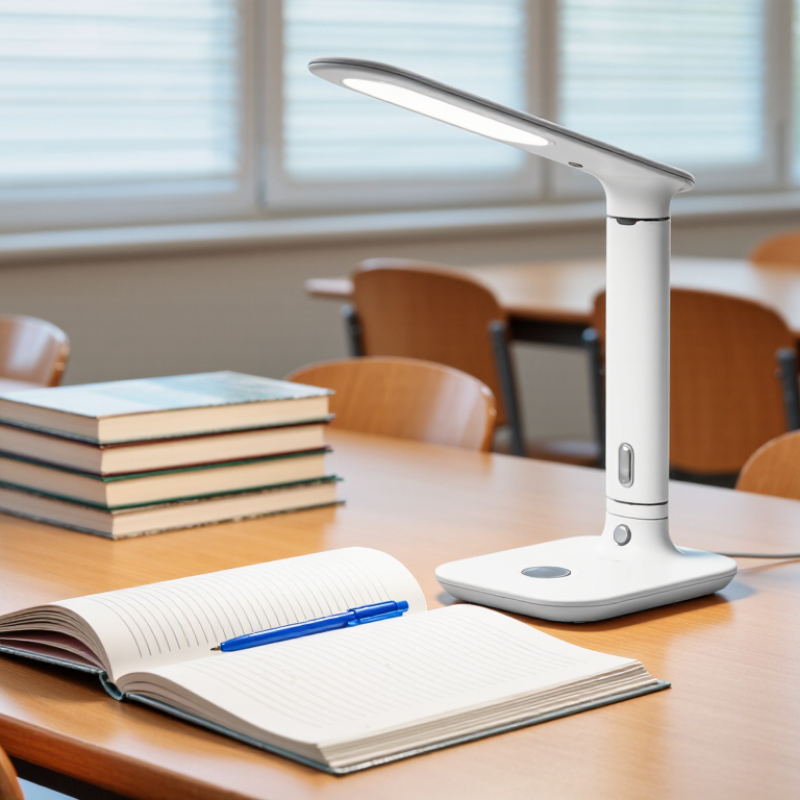
Why Choose a Battery Study Lamp for Schools?

Classroom Lighting Needs: EN 12464-1 Specifies 500 lx for Teaching Areas

A classroom needs more than a bright-looking ceiling. EN 12464-1 uses 500 lx as a maintained illuminance benchmark for many teaching areas. This means light measured on the working surface, such as a student’s desk, not the lamp’s brightness rating. Lux matters.

A battery study lamp can add focused light when a desk sits in a shadow, or when daylight fades during afternoon lessons. Look for a stable base, a glare-controlled head, and adjustable brightness. A teacher can check the desk with a lux meter, placing it flat where students read or write. Measurements may vary across the room. That detail is easy to miss.

A portable lamp is a supplement, not a substitute for balanced classroom lighting. One bright pool on a worksheet does not ensure even light across a teaching area, and reflections on a whiteboard can still distract students. Battery life also deserves a real-world test: a lamp that dims before the last lesson is not much help. Requirements can depend on the task and applicable standard edition, so schools should verify their lighting plan rather than treat 500 lx as a one-size-fits-all answer.


Visual Comfort Benchmarks: UGR ≤19 and Ra ≥80 for Classrooms

Why Choose a Battery Study Lamp for Schools?

A battery study lamp can keep reading areas usable during room changes or brief power interruptions. Yet portability should not come at the cost of visual comfort. EN 12464-1:2021 specifies 500 lux maintained illuminance, a UGR limit of 19, and a minimum Ra of 80 for general teaching classrooms. These are useful design benchmarks, not a guarantee that any single lamp makes a classroom compliant.

UGR describes discomfort glare from a lighting arrangement, not a lamp in isolation. CIE 117:1995 sets out the UGR method, which considers factors such as source brightness, room surfaces, and viewing position. In practice, a bright LED reflected in a glossy worksheet can still distract a pupil. Check the lamp from seated eye level, and avoid placing it directly in the line of sight. Small adjustment matters.

Ra indicates how faithfully a light source renders colors compared with a reference. With Ra ≥80, colored diagrams, map keys, and pencil marks are generally easier to distinguish. For battery models, check that the specification applies at normal brightness, since some lamps dim as charge falls. I would still test one in the actual classroom; a neat datasheet cannot show every reflection or shadow. A movable lamp helps. It does not replace balanced room lighting.

How Battery Study Lamps Support Learning During Power Outages

When the power fails, a classroom can change in seconds. The board goes dark, fans stop, and students lose the thread of a lesson. A battery study lamp provides a steady pool of light over a workbook or shared reading page. That can help learners continue quiet tasks instead of waiting in darkness. It is especially useful in schools where outages interrupt afternoon classes or exam preparation. Keep expectations realistic: one small lamp will not light an entire room.

Tips: Place the lamp on a stable desk, aim it toward the page, and keep the battery charged. Test its runtime beforehand. Use enough lamps for group work; shadows can make reading harder.

An outage plan works better when lamps are stored where staff can find them and checked routinely. Teachers should consider glare, brightness, charging access, and safe movement between desks. Battery lamps can be more dependable than phone screens for sustained reading, but they still need supervision. Their light may feel modest, and battery life varies with brightness and battery age. That limitation matters. Pairing lamps with a simple class routine—moving close to the light and pausing tasks that need full-room visibility—supports learning without pretending a lamp solves every problem.

Choosing School Lamps by Runtime, Battery Capacity, and Charging Safety

A school study lamp should last through the lessons and homework period it is meant to support. Check the stated runtime at the brightness students will actually use, not only the lowest setting. A lamp rated for ten hours may run for much less at full brightness. Test a sample during a typical school day, including brief use between classes. Small details matter.

Battery capacity helps explain runtime, but the largest number is not automatically the best choice. Compare capacity in watt-hours when possible, especially when lamps list different battery voltages. Also consider brightness, charging time, and how easily staff can replace or inspect the lamp. A simple log of charging dates can reveal whether units are losing runtime over a term. The figures can still be imperfect; real classrooms are messier than a product chart.

Charging safety deserves equal attention. Use the charger specified for the lamp, and keep charging areas dry, clear, and ventilated. Staff should check cables and plugs for fraying, heat, or damage before use. Set a routine for unplugging fully charged lamps if the product guidance recommends it. Avoid piling lamps together while charging, since heat needs room to escape. Clear instructions help students return lamps correctly, though routines take practice. A short trial with teachers can expose confusing steps before many lamps enter daily use.

Evaluating Maintenance Costs and Responsible Battery Disposal

Why Choose a Battery Study Lamp for Schools?

Battery study lamps can keep desks usable when outlets are scarce or power is interrupted. Their real cost, however, includes more than the purchase price. Schools should track battery life, charging time, replacement frequency, and staff hours spent checking units. A simple log can reveal which classrooms need replacements sooner. Dusty shelves, forgotten chargers, and lamps moved between rooms can distort the figures. Estimates are useful, but rarely perfect.

Tips: Label each lamp with its room and inspection date. Check batteries for swelling, leaks, or damage. Store spares in a cool, dry place, following the manufacturer’s instructions. Small details matter.

Responsible disposal belongs in the maintenance plan. Rechargeable batteries and single-use cells may need different collection routes, depending on local guidance. Keep used batteries in a clearly marked, secure container, away from heat and children. Do not assume ordinary rubbish collection is suitable; ask the school’s facilities team or local waste service where to take them. A missing battery record is easy to overlook, yet it can make both replacement costs and disposal harder to manage. Regular checks take time, but they help schools avoid waste and keep lamps ready for evening study.

Why Choose a Battery Study Lamp for Schools? — Evaluating Maintenance Costs and Responsible Battery Disposal
Evaluation Dimension Battery Study Lamp Plug-In Led Study Lamp School Planning Consideration
Practical Use and Maintenance
Use during a power interruption Can continue operating while its battery is charged. Stops operating if the outlet loses power. Battery models can support study during short outages; confirm runtime against the lamp’s specifications.
Placement flexibility Can be used away from a wall outlet until the battery needs charging. Must be placed within reach of a suitable outlet. Check that charging locations and storage arrangements are convenient and safe.
Routine checks Inspect charging cables and watch for reduced runtime or battery damage. Inspect the cord, plug, switch, and lamp for wear or damage. A simple inspection log helps staff identify lamps that need repair or removal from service.
Typical maintenance planning Budget for eventual battery replacement; timing depends on battery chemistry, charging habits, and use. No rechargeable battery to replace; other components can still wear out. Use the product’s warranty and battery-life information rather than assuming a fixed replacement interval.
Illustrative Five-Year Cost Model (Per Lamp)
Purchase price assumption $24.00 $18.00 Example planning figures only—not market averages or supplier quotes. Replace with local purchasing prices.
Replacement battery assumption $8.00 for one replacement pack during the five-year period $0.00 The model assumes one replacement; actual need depends on the battery and usage pattern.
Estimated electricity cost About $2.54 About $2.16 Illustration: 4 W light, 4 hours per day, 180 school days per year, five years, and electricity at $0.15/kWh. Battery-lamp estimate allows for charging losses.
End-of-life handling allowance $1.00 per lamp, assumed collection allowance $1.00 per lamp, assumed lamp/electronics handling allowance Actual collection costs vary. Use local waste-program guidance and obtain local service quotes.
Illustrative five-year total $35.54 per lamp $21.16 per lamp Excludes staff labor, repairs, taxes, and any residual value. The battery lamp’s potential outage and placement benefits are not assigned a dollar value.
Responsible Battery Disposal
Collection and storage Collect spent batteries separately; store them safely and protect terminals from short-circuiting. No lamp battery to collect unless the model has a separate battery-powered component. Keep damaged, swollen, hot, or leaking batteries out of routine storage and follow local safety instructions.
Disposal route Use an approved battery collection or recycling route appropriate to the battery chemistry and local rules. Use the school’s applicable electronic-waste or lamp collection route when the lamp is retired. Do not assume batteries belong in ordinary rubbish or mixed recycling; check local authority guidance and the battery label.
Records and purchasing Record battery type, collection date, and disposal route; prefer replaceable batteries where practical. Record retired equipment and use an appropriate reuse, repair, or recycling route. Before purchasing, check battery replaceability, warranty terms, and availability of a suitable take-back or recycling option.

Article Source:

REQUEST A QUOTE

Menu
[all-fields]