Where to Buy the Best Industrial Vacuum Cleaner in China?
Choosing where to buy the best Industrial Vacuum Cleaner in China requires more than comparing prices. Buyers need to match the machine to the dust, shift length, and cleaning area. A unit used beside a metalworking line faces different demands from one cleaning fine powder or workshop floors. Look closely at airflow, filtration, tank capacity, noise, and spare-parts availability. Small details matter.
China’s manufacturing base makes supplier selection especially relevant. The National Bureau of Statistics’ Statistical Communiqué on 2023 National Economic and Social Development reported that value added by industrial enterprises above designated size grew 4.6% year over year; manufacturing grew 5.0%. These figures describe industrial activity, not vacuum-cleaner sales. Still, they help explain why factories need dependable cleaning equipment. Grand View Research’s Industrial Vacuum Cleaner Market report offers additional market context, including product and application segments. Market forecasts, however, cannot verify an individual seller.
A useful buying guide should compare established manufacturers, specialist distributors, and verified online suppliers in China. Check factory credentials, filtration specifications, warranty terms, and written service commitments. Ask for a test using your actual material, if practical. Observe whether suction remains steady as the container fills, and request replacement-filter pricing. Then confirm lead times and export support before paying. It takes time. Yet a polished catalogue is not evidence of reliable performance; I have to admit, even a careful checklist cannot replace a real trial in your workplace.
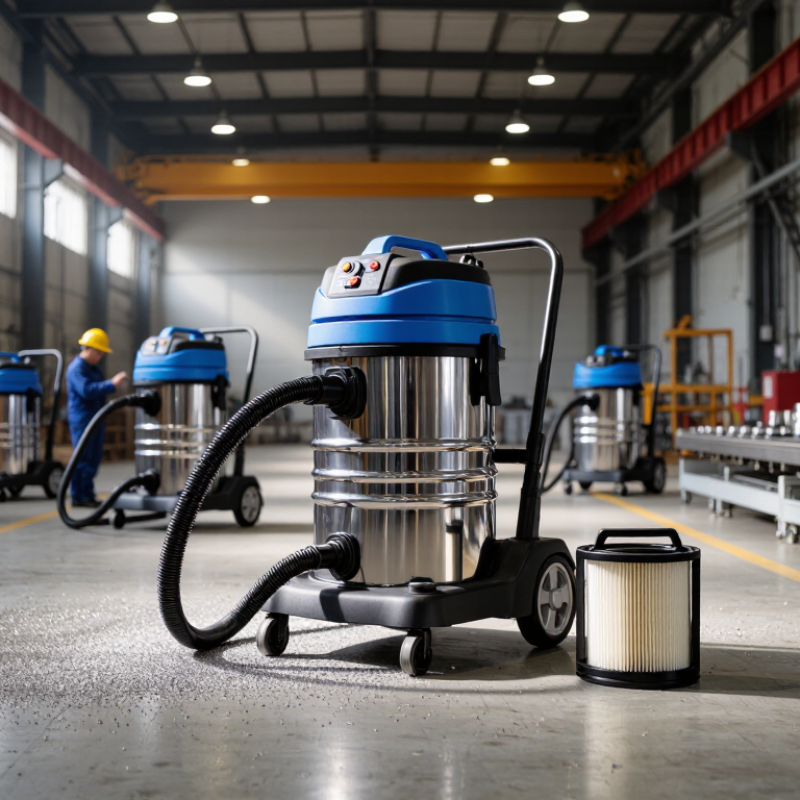
Industrial Vacuum Types and Applications Across Chinese Industries
Industrial vacuum selection depends on the material, shift length, and floor conditions. Dry single-phase units can suit small workshops and occasional cleanup. Three-phase machines are better suited to continuous collection of metal chips or production dust. Wet-and-dry models handle coolant spills and washdown areas, but collected liquids need compatible tanks and safe disposal procedures.
China’s industrial scale makes these distinctions practical, not theoretical. The World Steel Association’s World Steel in Figures 2024 reports 1,019.1 million tonnes of crude steel production in China in 2023. In steel shops, operators may need durable hoses and chip-resistant collection bins. The National Bureau of Statistics reported roughly 2.02 billion tonnes of cement output in 2023. Cement plants often need fine-dust filtration and filter-cleaning systems that resist clogging. Dust varies, though; a general-purpose unit may disappoint.
For food processing, smooth surfaces and easy-to-clean tanks can reduce residue buildup. In electronics workshops, fine-particle capture and careful handling matter more than raw suction alone. Ask suppliers for filter specifications, airflow data, and a trial using representative debris. A brochure is not a floor test. Before buying in China, verify replacement-filter availability, service response times, and whether the unit fits your actual duty cycle.
Industrial Vacuum Filter Classes for Common Applications in China
EN 1822 classifies filters by their minimum efficiency at the most penetrating particle size (MPPS). H13, H14, and U15 are benchmark classes to consider when evaluating industrial vacuums for fine-dust applications such as metalworking, woodworking, and pharmaceutical production. The appropriate vacuum and filter depend on the material, process, and applicable safety requirements.
Compare Suppliers Using IEC 60335-2-69 L, M, and H Dust Classes
Where to Buy the Best Industrial Vacuum Cleaner in China?
When comparing Chinese suppliers, ask for evidence behind each IEC 60335-2-69 dust-class claim. The standard’s L, M, and H classes are commonly expressed as minimum filtration efficiencies of 99%, 99.9%, and 99.995%. Check the test report, its standard edition, and whether the tested configuration matches the quoted machine. A filter certificate alone may not cover seals, collection bags, or the complete vacuum.
Match the class to the dust and work process, not just the purchase budget. The ILO’s 2023 global estimates report 2.93 million work-related deaths each year; this is not a vacuum-specific figure, but it underscores why exposure controls deserve careful review. Ask suppliers how they contain dust during filter changes and whether replacement filters are available locally. Request airflow data under realistic filter loading, not only a clean-filter figure. Small details matter.
A practical comparison includes test documentation, spare-part lead times, service coverage, and clear warranty terms. For fine or hazardous dust, ask for independent test evidence and site-specific risk advice. A polished brochure is not enough. I would also check the noise level beside the actual production line; that detail is easy to overlook. Some supplier claims still need closer scrutiny.
Check HEPA Claims Against the 99.97% at 0.3 μm Benchmark
When comparing industrial vacuum cleaners in China, treat “HEPA” as a test claim, not a complete performance guarantee. The U.S. EPA’s 2023 Guide to Air Cleaners in the Home describes HEPA filtration as capturing at least 99.97% of particles measuring 0.3 μm. Ask suppliers for the test report, filter grade, airflow, and test conditions. That distinction matters.
EN 1822-1:2019 rates H13 filters at a minimum overall efficiency of 99.95% and H14 at 99.995%, measured at the most penetrating particle size. These figures are not identical to the U.S. 99.97% benchmark. A certificate for a filter cartridge alone also does not prove that the assembled vacuum meets the same performance level. Check the housing seals, filter installation, and whether the complete machine was tested.
Look closely at the dust bin lid and filter frame. A small gap can let fine dust bypass the media, especially after repeated emptying. Request documentation tied to the exact vacuum model, not a similar unit. Not the cartridge alone. I would still verify the report with its issuing laboratory; paperwork can look convincing while leaving important test details unclear.
Assess Dust-Control Needs Against OSHA’s 50 μg/m³ Silica PEL
Where to Buy the Best Industrial Vacuum Cleaner in China?
OSHA’s respirable crystalline silica permissible exposure limit is 50 μg/m³ as an eight-hour time-weighted average. That figure is a workplace exposure limit, not a vacuum’s performance rating. A machine alone cannot prove that a worksite meets the limit. Measure the task, material, and work area before choosing equipment. Cutting concrete indoors, for example, needs a different control plan than occasional cleanup in a ventilated workshop. Dust can linger near the floor. It can also travel on clothing.
When sourcing in China, ask suppliers for airflow and filtration specifications, filter-cleaning details, and test documentation for the complete system. Check whether the vacuum suits the tool’s required airflow and hose size. A high-efficiency filter matters, but poor seals or a full filter can undermine performance. Ask about replacement filters, maintenance instructions, and local technical support. Review the documents carefully. They may not answer every site-specific question.
Tips: Match the vacuum to the dust-producing tool, and capture dust at the source. Inspect hoses and seals regularly. Keep a simple maintenance log. If exposure remains uncertain, arrange competent air monitoring; don’t rely on the vacuum label alone. One practical detail is easy to miss: workers may disturb settled dust while emptying a collection container. Plan that step, too.
Choose Between Chinese Manufacturers, OEMs, and Industrial Distributors
Where to Buy the Best Industrial Vacuum Cleaner in China?
Choose Between Chinese Manufacturers, OEMs, and Industrial Distributors
Buying directly from a Chinese manufacturer can suit projects that need custom airflow, filtration, or tank capacity. Ask for test records from a comparable machine, not just a polished product sheet. Check performance against your actual material, such as fine powder, damp debris, or metal chips. A factory call can clarify technical details, but confirm every promised feature in writing.
An OEM may offer a practical middle ground when you need a specific configuration without managing every production detail. Industrial distributors are worth considering when local stock, installation, or faster service matters. Compare their spare-parts access, technician response times, warranty terms, and shipping costs. A lower quote can become less attractive if filters take weeks to arrive. I would not choose on price alone; even a neat specification table can miss daily maintenance needs.
Tips: Send suppliers a short list of materials, operating hours, and hose dimensions. Request a sample test or video using similar debris. Ask who handles repairs after delivery. Small details matter. Sometimes the right supplier is the one who answers awkward questions clearly.