
What Is a Refractory Castable Mixer Machine?
A Refractory Castable Mixer Machine blends refractory cement, graded aggregates, and other dry ingredients with water. Its purpose is to produce a consistent castable that can be placed around furnace linings, kiln walls, or industrial equipment. The machine may use a pan, planetary, or other forced-action mixing system. Designs vary, so the right choice depends on batch size, material behavior, and site conditions.
Good mixing is more than making the material look uniform. Operators need to follow the castable supplier’s instructions, add water in controlled amounts, and allow enough mixing time. Too much water can affect strength and drying behavior. Poorly dispersed powder may leave dry pockets or uneven patches. Small details matter. A clean mixing pan matters, too.
In practice, the mixer is only one part of the process. A sound recipe, accurate weighing, and trained operation all influence the result. Even a capable machine cannot repair poor material storage or incorrect proportions. That point is easy to overlook. Before purchasing, compare capacity, power requirements, discharge method, cleaning access, and spare-parts support. Ask for performance data using materials similar to those used at your site, since published capacity alone may not predict real output. This guide explains how the equipment works, what features deserve attention, and where careful operation makes a difference. Some choices still depend on actual trials, not specifications alone.
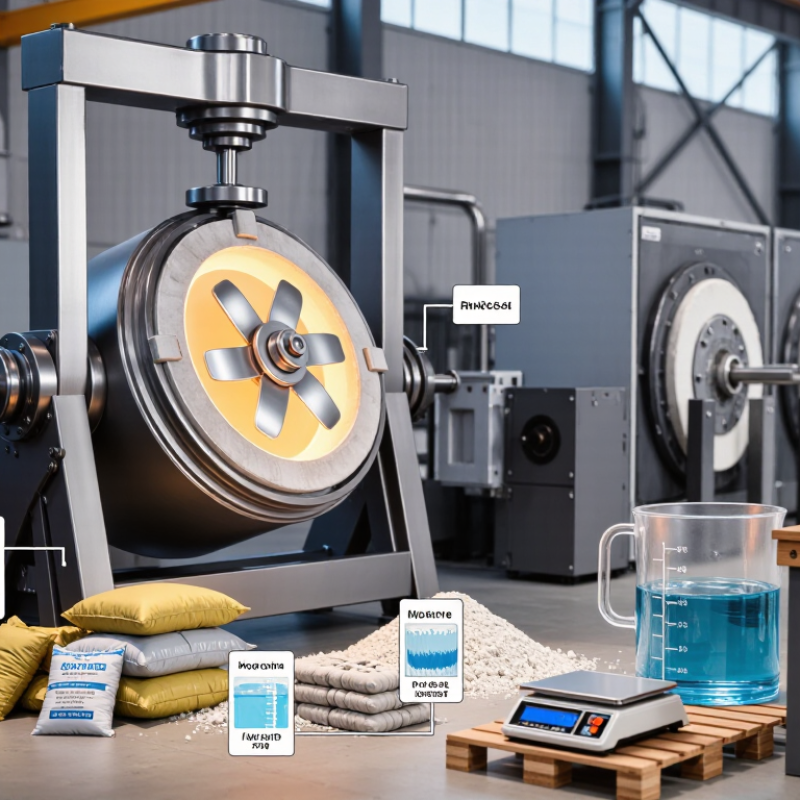
What a Refractory Castable Mixer Does in Monolithic Refractory Production
What Is a Refractory Castable Mixer Machine?
In monolithic refractory production, a castable mixer combines graded aggregates, fine powders, and other dry ingredients into a consistent batch. After dry blending, measured water or a specified liquid binder is added. The machine’s mixing action helps distribute these materials throughout the batch, so installers can place the castable with more predictable flow and workability.
That sounds simple. It isn’t. Too little mixing can leave dry pockets or uneven binder distribution; excess water can weaken the installed lining. Operators therefore follow the castable supplier’s mixing instructions, control liquid addition, and watch the batch as it changes from loose powder to a cohesive mix. The right sequence and mixing time depend on the formulation and equipment.
A mixer also supports repeatable production between batches, which matters when lining furnaces, kiln zones, or other hot-face surfaces. Check that the drum or mixing pan is clean before loading; old material can contaminate a fresh batch. Inspect mixing blades for wear, too. A worn blade may still turn, but it can leave unmixed material near the edges. Even careful operation cannot make every batch perfect, so consistency should be checked before placement.
What Is a Refractory Castable Mixer Machine? - What a Refractory Castable Mixer Does in Monolithic Refractory Production
| Production Stage | Materials or Input | Mixer Machine Function | Typical Operating Reference | Quality Check |
|---|---|---|---|---|
| Batch preparation | Refractory aggregates, fine powders, cement or other binders, and permitted additives | Receives measured ingredients in a defined recipe and prepares them for mixing. | Ingredient proportions are set by the castable formulation; there is no single recipe suitable for every product. | Verify material identity, batch weights, and ingredient condition before charging. |
| Dry blending | Dry aggregates, fines, binders, and dry additives | Forced-action mixing circulates material through the mixing zone to distribute particle sizes and dry ingredients. | About 1–3 minutes is a commonly used starting range; actual time depends on the mixer, batch, and recipe. | Check for visible streaks, pockets of unmixed powder, or separation. |
| Liquid addition | Mixing water or another liquid specified by the product formulation | Introduces liquid in a controlled manner while the mixing action helps disperse it through the dry blend. | Addition rate and quantity are formulation-specific. Follow the product instructions rather than using a universal water percentage. | Measure the liquid accurately and avoid unapproved extra additions. |
| Wet mixing | Dry-blended materials combined with the specified liquid | Continues mixing until the castable reaches a consistent, workable condition for placement. | About 2–5 minutes after liquid addition is an indicative starting range, not a universal setting. | Assess consistency and uniformity using the product’s specified placement or workability checks. |
| Discharge and placement | Freshly mixed monolithic refractory castable | Discharges the batch for immediate transport and installation by the specified placing method. | Discharge promptly and observe the product’s stated working time and installation instructions. | Look for a uniform batch without obvious dry pockets, excess liquid, or segregation. |
| Batch and equipment control | Recipe records, mixer condition, and cleaned mixing surfaces | Supports repeatable batches and helps prevent residues from affecting later mixes. | Record batch quantities and mixing times; clean the machine between products or as required by the operating procedure. | Inspect mixing elements and the vessel for wear, buildup, or contamination. |
| Note: Time ranges are general planning references only. Required mixing time and workability depend on the castable formulation, batch size, mixer design, material temperature, and installation method. Always follow the product data and equipment operating instructions. | ||||