
What Are the Top Track Light Fixtures?
Choosing the top Track Light Fixtures is not just a matter of picking the brightest rail. The right system should direct light where it is needed, fit the room’s style, and remain practical to install and maintain. A kitchen island may need focused task lighting, while a living room benefits from adjustable heads that highlight artwork without creating harsh glare.
The International Energy Agency estimates that lighting accounts for about 15% of global electricity consumption. That figure makes efficiency worth considering, though it does not tell you which fixture will suit your space. For a useful comparison, this guide looks at beam control, dimming compatibility, light quality, build materials, and installation flexibility. Small details matter. A poorly aimed head can leave a bright patch on a wall and a dim countertop below.
Lighting designer Howard Brandston captured the broader principle: “Light is a thing that cannot be seen. What is seen is the effect of light.” Track systems make that effect adjustable, but more adjustment is not always better. Too many heads can clutter a ceiling; too few may leave corners gloomy. There is no perfect setup for every room. We will compare leading fixture types and explain what to check before buying, including bulb compatibility, track standards, and whether the system suits your existing wiring. One caveat: product specifications can look impressive on paper, yet real results depend on ceiling height, surface color, and careful aiming.
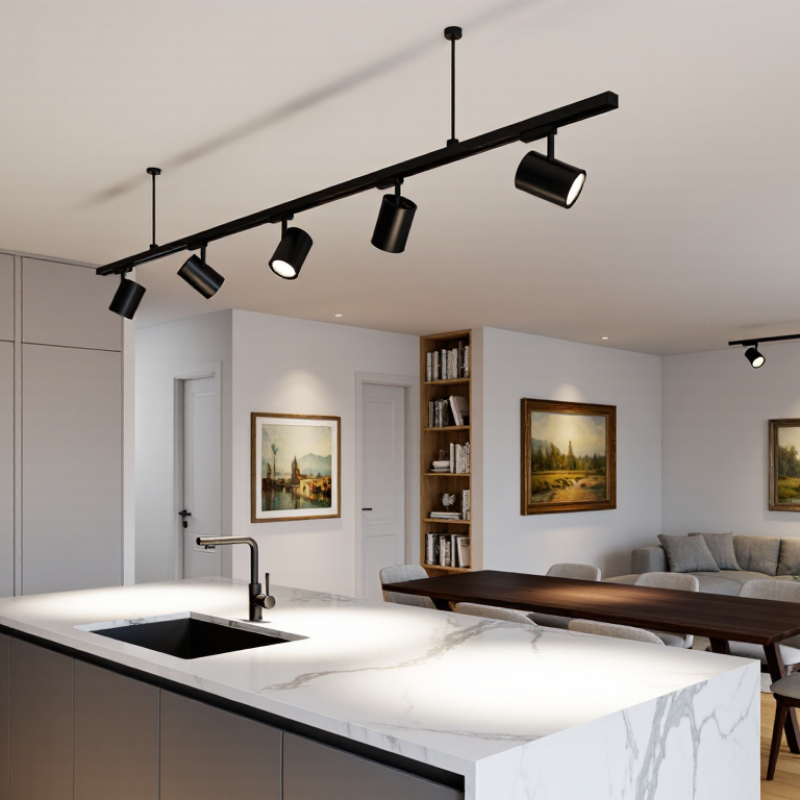
What Are Track Light Fixtures? Rails, Adapters, Drivers, and Adjustable Heads
What Are the Top Track Light Fixtures?
Track light fixtures combine a ceiling-mounted rail with movable light heads. The rail carries power, while each head can slide or turn to aim light at a counter, artwork, or reading chair. This flexibility suits rooms where furniture or displays may change. Yet a good fixture depends on more than appearance. The rail must match the room’s layout, ceiling conditions, and lighting needs.
Adapters connect compatible heads to the rail and help keep them secure. Check the track type before buying; similar-looking systems may not fit together. Some fixtures also use a separate driver, which regulates electrical power for the lights. Confirm that the driver’s output suits the heads, and allow access for maintenance. Adjustable heads are useful, but their beam angle matters: a narrow beam can create bright spots, while a wider one spreads light more softly. It is easy to focus on the rail and overlook glare at eye level. That detail deserves a second look.
Tips: Sketch the rail and target areas before installation. Test head positions after dark, when reflections are easier to spot. Leave room to reposition heads, and verify compatibility across every component. Small mismatches can mean an annoying return.
| Fixture Type | Typical Rail | Adapter | Driver or Power Supply | Typical Head and Output | Common Beam Angle | Typical Color Temperature | Best Suited For |
|---|---|---|---|---|---|---|---|
| Line-voltage adjustable LED spotlight | 120 V single-circuit track | Matching single-circuit track adapter; rail and adapter must use the same system | Usually an integrated driver inside the head; connects to line-voltage track | Approximately 7–20 W and 600–1,800 lumens per head | About 15°–40° | 2700–4000 K | Accent lighting for artwork, shelving, and residential rooms |
| Two-circuit LED spotlight | 120 V two-circuit track | Two-circuit adapter compatible with the rail; circuit selection depends on the adapter design | Usually integrated into each LED head; no separate track-mounted driver in many systems | Approximately 8–25 W and 700–2,200 lumens per head | About 20°–50° | 2700–4000 K | Spaces where separate groups of track heads need independent switching |
| Low-voltage miniature spotlight | 12 V or 24 V low-voltage track system | Low-voltage adapter designed for the specific track system | Requires a compatible transformer or LED driver; total load must stay within its rated capacity | Approximately 5–12 W and 350–900 lumens per head | About 15°–40° | 2700–3500 K | Display cases, compact retail displays, and installations needing small heads |
| High-output LED track head | 120 V line-voltage track, subject to system rating | Adapter rated for the rail and the head’s electrical load | Typically integrated into the head; confirm compatibility with the track voltage | Approximately 20–35 W and 1,800–3,000 lumens per head | About 25°–60° | 3000–4000 K | Higher ceilings, larger retail areas, and brighter general or accent lighting |
| Adjustable gimbal LED head | Usually 120 V single- or two-circuit track | Adapter matched to the track profile and circuit configuration | Generally integrated LED driver; verify dimmer compatibility when dimming is required | Approximately 8–20 W and 600–1,800 lumens per head | About 20°–40°; head can tilt and rotate | 2700–4000 K | Angled ceilings, wall washing, and aiming light around architectural features |
| Linear LED track module | Track system specified for the module; some designs use proprietary rails | Module connector or adapter specified for that track family | Integrated or remote driver, depending on the module design | Typically 10–40 W per module, with output varying by length and design | Broad, diffuse distribution rather than a narrow spotlight beam | 3000–4000 K | Even illumination across counters, work surfaces, and display runs |
| Selection note: Track rails, adapters, and heads are not universally interchangeable. Match the adapter to the exact rail system, check voltage and circuit requirements, and confirm that any external driver or transformer is suitable for the connected LED load. Output and performance vary by fixture design. | |||||||