

- 713.590.1312
- sale@pandbtools.com
Top TFT LCD Display Manufacturers in China Who Is Best?
Choosing among China’s TFT LCD Display manufacturers requires more than comparing factory prices. It demands practical judgment, technical knowledge, and evidence from real projects. A bright panel may look impressive in a sample room. It can still fail under sunlight, vibration, heat, or repeated touch.
China remains a major production base for TFT LCD Display modules, panels, and customized solutions. Its manufacturers serve automotive systems, medical devices, industrial controls, retail equipment, and consumer electronics. However, “best” depends on your application. A medical monitor needs stable brightness, consistent color, long-term availability, and strict quality controls. A handheld terminal may prioritize low power consumption, touch integration, and compact dimensions.
Display analyst Bob Raikes has described the market plainly: “The display industry is a very cyclical industry.” That reality matters when evaluating suppliers. Strong companies should explain their production capacity, inspection process, component sourcing, and after-sales support. They should also provide clear samples, test reports, and realistic delivery schedules.
Look beyond polished websites.
A reliable manufacturer should answer practical questions without vague promises. Can it maintain panel consistency across large batches? Can it modify the interface, bonding method, or backlight design? Does it communicate problems before shipment? These details reveal manufacturing maturity.
This guide compares leading Chinese TFT LCD Display manufacturers through technology, quality, customization, pricing, production experience, and service. No supplier is perfect. Even respected companies may have weaknesses in communication, minimum order quantities, or response speed. Buyers should verify claims independently and test samples in actual working conditions before making a final decision.
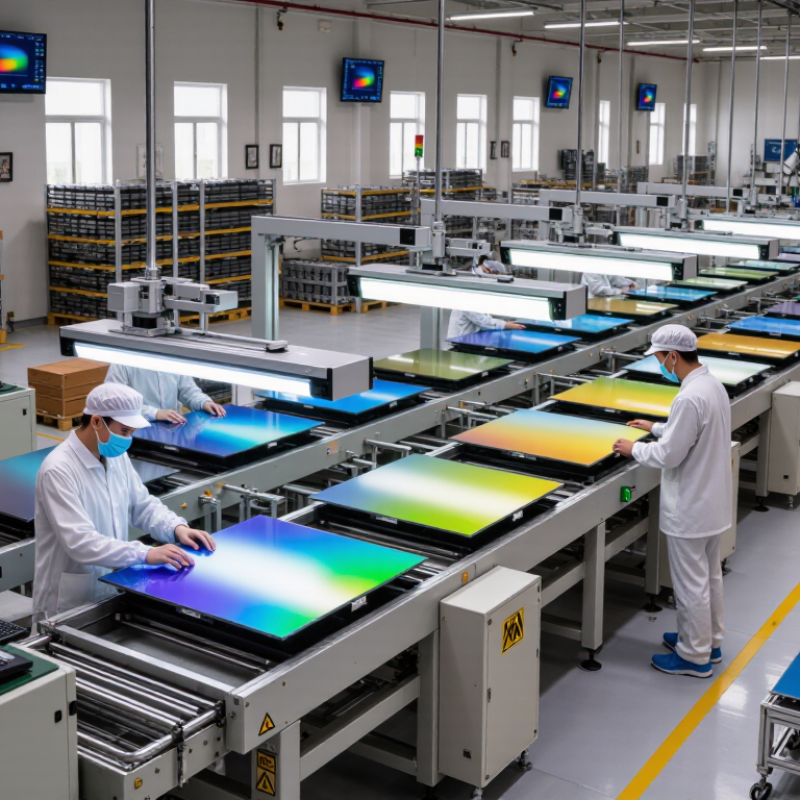
TFT LCD Displays: Technology, Structure, and Main Applications
TFT LCD displays use thin-film transistors to control individual pixels with accurate electrical signals. Each pixel contains liquid crystal material between two glass substrates. A backlight provides illumination, while polarizers, color filters, and a driver IC shape the final image. Some modules also include a touch layer, protective glass, or optical bonding.
Panel technology affects performance. IPS panels usually provide wide viewing angles and stable colors. TN panels can offer fast response and lower cost. VA panels often deliver stronger contrast. These differences matter in industrial monitors, medical instruments, vehicle interfaces, point-of-sale terminals, and portable equipment. In practice, a display that looks excellent in a showroom may perform poorly under sunlight, gloves, vibration, or low temperatures. That is an easy detail to underestimate.
Tips: Ask manufacturers for brightness data, viewing-angle tests, operating-temperature limits, and sample results. Check the backlight lifetime and driver compatibility. A reliable supplier should explain tolerances, inspection methods, and replacement procedures clearly. Do not judge quality only by price. The best choice depends on optical performance, mechanical fit, software support, and stable production. Engineers sometimes focus too heavily on resolution. Power use, cable routing, and long-term availability can matter more. Mistakes still happen, so prototype testing remains necessary before mass production.

China’s TFT LCD Manufacturing Industry and Market Development
China’s TFT LCD industry has become a central force in global display production. Omdia estimated that China held about 70% of worldwide LCD capacity in 2023. This scale comes from large-generation fabs, dense supplier networks, and strong domestic demand. Glass substrates, driver components, testing equipment, and logistics often operate within the same industrial regions.
Market development is changing the definition of the best manufacturer. TrendForce reports that large-size LCD demand remains closely linked to televisions, monitors, and commercial displays. However, automotive screens and information terminals are gaining importance. These products require stable brightness, wide temperature performance, and long service cycles. A factory may offer attractive pricing, yet weak yield control can create hidden costs through rework and delayed delivery.
The industry is not perfectly balanced. Capacity expansion has sometimes pressured panel prices and factory utilization. That deserves careful reflection. According to Omdia’s display supply-and-demand research, utilization and investment discipline are becoming more important than simple capacity growth. Manufacturers with strong process traceability can identify particles, line defects, and color variation earlier. In practical audits, buyers should examine aging-test records, monthly yield data, sample consistency, and emergency response times. IDC’s device shipment research also shows that changing PC and commercial-device demand can quickly affect panel orders. Market leadership, therefore, depends on dependable execution, not only factory size.
China’s TFT LCD Manufacturing Industry and Market Development
Estimated share of global LCD panel production capacity located in China, 2019–2024.
China’s share of global LCD capacity increased substantially during this period, supported by new-generation fabrication lines, domestic supply-chain investment, and industry consolidation. Values are rounded industry estimates based on publicly reported Omdia and TrendForce market research.
Key Criteria for Comparing Chinese TFT LCD Display Manufacturers
Top TFT LCD Display Manufacturers in China: Who Is Best?
Key Criteria for Comparing Chinese TFT LCD Display Manufacturers
Choosing among Chinese TFT LCD display manufacturers requires more than comparing quoted prices. A reliable evaluation begins with the panel itself: size, resolution, brightness, viewing angle, interface, and operating temperature. Ask for measured data, not only catalog values. Request samples from the intended production line. During a factory review, I check uniformity at low brightness, connector quality, and whether protective films leave residue. Small details often reveal process discipline.
Manufacturing capability deserves equal attention. Review cleanroom controls, glass handling, bonding equipment, calibration records, and inspection checkpoints. A supplier should explain its quality system in practical terms. Traceability matters when a defective batch appears months later. Confirm how serial numbers, materials, firmware, and test results are recorded. Also examine production capacity during peak seasons. A factory that promises unlimited volume may be overconfident. That is a warning sign.
Commercial criteria can change the real cost. Compare tooling charges, minimum order quantities, lead times, packaging, warranty terms, and engineering support. Clarify who pays when a design revision affects the mold or driver board. Technical communication is often underestimated. Ask engineers to review drawings, interface timing, touch performance, and sunlight behavior before approval. I have seen attractive samples fail after thermal cycling. That experience makes me cautious about fast approvals. No scorecard is perfect, so document assumptions and leave room for independent testing.
Leading Chinese TFT LCD Manufacturers and Their Core Strengths
China’s TFT LCD manufacturing sector covers small displays for wearables, medium panels for vehicles, and large screens for industrial equipment. Leading suppliers usually stand out through stable production, practical engineering, and flexible customization. Their core strengths often include high-volume cell processing, accurate backlight assembly, and reliable driver-board integration.
In factory evaluations, production discipline matters more than a glossy sample. A capable manufacturer can explain pixel defects, brightness tolerance, viewing angles, and temperature performance in clear terms. It should also provide inspection records, aging-test results, and traceable batch data. These details reveal more than marketing language. Fast prototyping is another advantage, especially when a project needs a custom outline, connector position, or touch solution.
The strongest Chinese manufacturers often combine large supply chains with responsive technical teams. They can coordinate glass, backlight, touch panels, and electronic components within one project. That reduces communication gaps and shortens revision cycles. Yet the picture is not always perfect. Some suppliers perform well on standard panels but struggle with low-volume customization. Others offer attractive prices while leaving testing responsibilities unclear. Buyers should check samples under sunlight, gloves, vibration, and long operating hours. A display that looks excellent on a desk may behave differently inside a heated machine. Supplier selection still requires patience, documented tests, and a willingness to question convenient promises.
Top TFT LCD Display Manufacturers in China Who Is Best? - Leading Chinese TFT LCD Manufacturers and Their Core Strengths
A practical comparison of common strengths, technologies, production capabilities, and application expertise found among leading Chinese TFT LCD manufacturing profiles.
| Anonymous Manufacturer Profile | Primary Core Strength | Typical Display Sizes | Common TFT Technologies | Touch and Interface Options | Typical Application Areas | Customization Capability | Quality and Compliance Focus | Best Fit for Buyers | Overall Strength Rating |
|---|---|---|---|---|---|---|---|---|---|
| Profile A Industrial Display Specialist | Reliable displays for demanding industrial environments | 3.5–15.6 inches | TN IPS High-brightness TFT | Projected capacitive touch, resistive touch, HDMI, LVDS, RGB, MIPI DSI | Factory automation, measurement equipment, control panels, industrial handheld devices | Custom cover glass, bezels, mounting holes, cable assemblies, brightness levels, and operating temperatures | RoHS and REACH support; emphasis on extended operating life, vibration resistance, and stable supply | Customers requiring dependable displays for long-term industrial programs | ★★★★★ |
| Profile B Embedded HMI Specialist | Fast integration of display and touch HMI solutions | 4.3–13.3 inches | IPS AHVA-type Wide-viewing-angle TFT | On-cell and glass-glass touch, USB, UART, I²C, SPI, RGB, LVDS | Medical instruments, smart home equipment, access control, POS terminals, information kiosks | Touch-panel bonding, anti-glare treatment, optical enhancement, custom icons, and user-interface integration | RoHS and REACH support; focus on touch accuracy, optical clarity, and assembly consistency | OEMs seeking a ready-to-integrate HMI module rather than a bare LCD panel | ★★★★★ |
| Profile C Automotive and Transportation Display Specialist | High-brightness and wide-temperature display solutions | 5.0–15.6 inches | IPS High-transmittance TFT Wide-temperature TFT | Projected capacitive touch, LVDS, MIPI DSI, CAN-related system integration support | Vehicle information systems, charging stations, fleet equipment, marine instruments, transportation terminals | Sunlight-readable panels, anti-reflection coatings, optical bonding, custom connectors, and ruggedized housings | RoHS and REACH support; emphasis on thermal performance, vibration tolerance, and long-term availability | Projects exposed to sunlight, temperature changes, vibration, or continuous operation | ★★★★☆ |
| Profile D Consumer and Commercial Display Specialist | Competitive pricing and high-volume production | 2.4–10.1 inches | TN IPS Standard TFT | Projected capacitive touch, resistive touch, RGB, MCU, SPI, MIPI DSI | Consumer electronics, smart appliances, handheld terminals, education devices, retail equipment | Custom FPC, connector position, active area, backlight color, touch layout, and packaging | RoHS and REACH support; emphasis on production efficiency, yield, and cost control | Buyers prioritizing unit cost, standard formats, and medium-to-large production volumes | ★★★★☆ |
| Profile E Small-Batch Custom Display Specialist | Flexible engineering support for customized projects | 1.3–7.0 inches | TN IPS Monochrome-compatible solutions | Resistive touch, projected capacitive touch, SPI, I²C, UART, RGB | Portable instruments, laboratory devices, access systems, specialty electronics, IoT equipment | Custom shapes, narrow bezels, FPC design, touch sensors, backlights, logos, and mechanical integration | RoHS and REACH support; emphasis on prototype validation, engineering communication, and small-order flexibility | Start-ups and equipment manufacturers needing samples or lower-volume custom modules | ★★★★☆ |
| Profile F Large-Format HMI Specialist | Large display modules with strong visual performance | 10.1–32 inches | IPS Wide-viewing-angle TFT High-brightness TFT | Projected capacitive touch, HDMI, DisplayPort-compatible solutions, LVDS, eDP | Industrial terminals, digital signage, medical monitors, conference systems, commercial equipment | Optical bonding, anti-glare glass, custom enclosures, touch overlays, brightness enhancement, and thermal design | RoHS and REACH support; emphasis on uniformity, thermal management, and structural durability | Applications needing a larger interactive screen with stable image quality | ★★★★☆ |
How to Select the Best TFT LCD Manufacturer for Your Project
Choosing the best TFT LCD manufacturer in China starts with your project requirements, not a factory ranking. Define screen size, resolution, viewing angle, brightness, touch method, and operating temperature. A 4.3-inch industrial display may need sunlight readability, while a handheld product may prioritize low power consumption. Ask manufacturers for matching samples before discussing mass production.
Evaluate technical experience carefully. Review their optical test methods, pixel defect limits, backlight uniformity, and touch-panel alignment process. Request recent inspection records, reliability test results, and production photographs. Confirm whether engineering staff can support custom cables, mounting holes, and interface changes. A reliable supplier should explain risks clearly, including possible color variation between trial and mass-production batches.
Tips: Compare at least three manufacturers using the same specification sheet. Test samples under real lighting, gloves, vibration, and temperature conditions. Check response time and viewing angles yourself. Ask about tooling ownership, lead times, warranty terms, and replacement procedures. Do not rely only on a polished factory tour. I have seen attractive samples hide weak connector designs and uneven backlights. That mistake becomes expensive later. A supplier with strong certifications may still be unsuitable if communication is slow or documentation is incomplete. Leave room for engineering changes, because the first design is rarely perfect.