

- 713.590.1312
- sale@pandbtools.com
Top 10 Electric Stacker Lift Manufacturers for Buyers
An Electric Stacker Lift can look simple on a product page: forks, a mast, and a battery. On a warehouse floor, small differences matter. Aisle width, pallet condition, lift height, and daily travel distance all shape the right choice. A unit that fits the load but cannot turn comfortably may slow every shift.
The investment also sits within a wider push to modernize material handling. MHI’s 2024 Annual Industry Report, produced with Deloitte, reported that 55% of surveyed supply-chain professionals planned to increase technology investment over the following two years. That figure covers supply-chain technology broadly; it is not a forecast for stacker sales. Still, it helps explain why buyers are comparing equipment, service, and data with greater care. The report is a useful signal, not a purchasing answer.
This guide reviews ten manufacturers through practical buyer criteria: rated capacity, lift range, turning radius, battery options, operator visibility, and access to replacement parts. Compare specifications against the actual route, including ramps, floor joints, and the tight turn beside the loading bay. Ask how quoted performance changes under continuous use. Get the details in writing. Manufacturer claims deserve careful checking, and a polished brochure cannot reveal every maintenance delay. No shortlist removes that work. The right supplier is the one whose equipment and support fit your operation, not simply the one with the longest feature list.
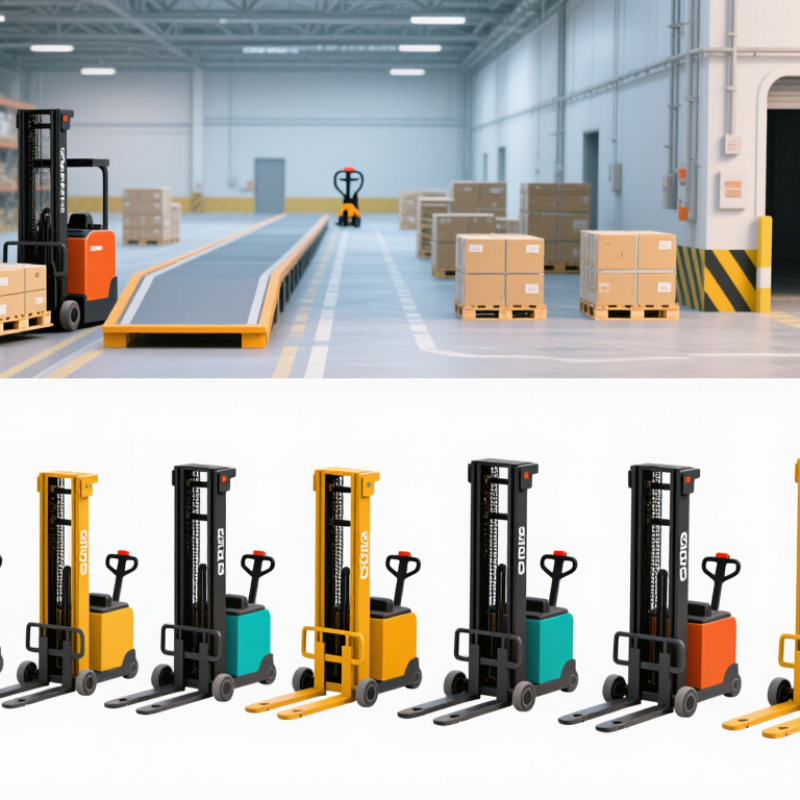
Define Electric Stackers Under ISO 3691-1 and ANSI/ITSDF B56.1
An electric stacker is defined by its design and task, not by its sales label. It uses powered travel or lifting to raise palletized loads, typically with a mast and forks. ISO 3691-1 sets safety requirements and verification methods for specified self-propelled industrial trucks. ANSI/ITSDF B56.1 addresses low-lift and high-lift trucks, including applicable pedestrian-operated designs. Scope depends on the truck’s configuration, controls, and intended use. Check the relevant edition and local adoption.
Look beyond the rated capacity. A stacker’s load center, mast height, braking, steering, and emergency controls affect safe operation in tight aisles. OSHA’s Powered Industrial Trucks eTool has cited estimates of about 85 annual forklift-related fatalities and 34,900 serious injuries in the United States. These figures cover powered industrial trucks broadly, not stackers alone. Still, they show why standards and operator training matter. A practical inspection should include fork condition, warning devices, and a clear view of the travel path. Small details matter. One point deserves reflection: a compliant machine can still be poorly matched to a narrow aisle or uneven floor. Safety depends on the truck, the load, and the worksite together.

Compare Rated Capacity, Lift Height, and Aisle Requirements Across 10 Manufacturers
Top 10 Electric Stacker Lift Manufacturers for Buyers
Compare Rated Capacity, Lift Height, and Aisle Requirements Across 10 Manufacturers
When comparing ten electric stacker suppliers, place rated capacity, lift height, and aisle needs side by side. Start with your heaviest pallet, not the average one. A 1,200-kilogram rating may change when the load center moves outward or an attachment is fitted. Check the capacity chart at the actual lift height. Also measure pallet length, fork dimensions, and load shape. A tall carton can affect stability even when it weighs less than the rated limit. Small details matter.
Aisle width is not just the machine’s body width. Request the turning radius and right-angle stacking aisle figure, then test them against your narrowest rack bay. Leave room for the operator to correct a crooked approach. MHI’s 2024 Annual Industry Report found that 55% of surveyed organizations planned to increase supply-chain technology investment. That investment makes fit checks more valuable, not less. A sophisticated truck still cannot turn where the aisle is too tight.
Compare maximum lift height with the top beam and required overhead clearance. Ask for residual capacity at that height, especially if loads vary. Record battery type, charging access, and expected shifts too; they affect daily availability. Measure twice. A neat specification sheet can still mislead if it assumes a standard pallet or smooth floor. Before choosing, verify the proposed model in a marked aisle with a representative load.
Assess Battery Options and Operating Data for Each Electric Stacker Brand
When comparing electric stacker manufacturers, look beyond advertised battery capacity. Check whether each model uses lead-acid or lithium-ion batteries, and confirm the stated voltage and amp-hour rating. These figures help frame a comparison, but they do not predict a full shift by themselves. Numbers need context. Ask for runtime data under a load similar to yours, including lift height, travel distance, and starts per hour. A unit moving occasional pallets behaves differently from one working continuously in a narrow aisle.
Review charging time, battery access, and any opportunity-charging guidance alongside runtime. Confirm whether the quoted operating hours assume a new battery, moderate loads, or ideal floor conditions. Ask how performance changes near the battery’s low-charge threshold. Small details matter. A useful supplier should provide test conditions, not just a headline number. During a site trial, record pallets moved, lift cycles, idle time, and remaining charge at shift end. Compare those results across models using the same route and load. One imperfect point: trials rarely reproduce every busy-day interruption. Keep a modest reserve in your estimate, and check whether the battery can be replaced or serviced without disrupting the work area.
| Supplier Profile | Common Battery Options | Typical Battery Configuration | Rated Capacity | Typical Lift Height | Travel Speed, Loaded / Unloaded | Gradeability, Loaded | Buyer Consideration |
|---|---|---|---|---|---|---|---|
| Profile 1 — Entry-level walkie stacker | Lead-acid; lithium-ion on selected configurations | 24 V; approximately 80–100 Ah | 1,000–1,200 kg | 1.6–3.0 m | 4.0 / 4.5 km/h | About 5% | Suitable for light-to-moderate indoor use; check whether the battery and charger are included. |
| Profile 2 — Compact warehouse stacker | Lead-acid or lithium-ion | 24 V; approximately 100–120 Ah | 1,200–1,400 kg | 2.0–3.5 m | 4.0 / 5.0 km/h | About 5–6% | Compare overall length and turning radius against aisle width and pallet dimensions. |
| Profile 3 — General-purpose walkie stacker | Lead-acid; lithium-ion option | 24 V; approximately 120–150 Ah | 1,400–1,600 kg | 2.5–4.0 m | 4.0 / 5.0 km/h | About 5–6% | Confirm residual capacity at maximum lift height; rated load can decrease as lift height increases. |
| Profile 4 — High-lift warehouse stacker | Lead-acid or lithium-ion | 24 V; approximately 150–200 Ah | 1,200–1,600 kg | 3.5–5.5 m | 3.5 / 5.0 km/h | About 5% | Request the load chart and mast-deflection details for the actual lift height required. |
| Profile 5 — Lithium-focused compact stacker | Lithium-ion; some configurations may offer lead-acid | 24 V; approximately 60–100 Ah | 1,000–1,200 kg | 1.6–3.5 m | 4.0 / 5.0 km/h | About 5% | Check battery chemistry, battery-management protections, charger compatibility, and replacement cost. |
| Profile 6 — Heavy-duty walkie stacker | Lead-acid or lithium-ion | 24 V; approximately 180–250 Ah | 1,600–2,000 kg | 2.0–4.0 m | 3.5 / 4.5 km/h | About 4–5% | Check floor loading, chassis weight, and battery runtime under the planned load cycle. |
| Profile 7 — Straddle-leg stacker | Lead-acid; lithium-ion option | 24 V; approximately 100–150 Ah | 1,000–1,500 kg | 2.5–4.5 m | 3.5 / 4.5 km/h | About 5% | Straddle legs can handle closed-bottom pallets; verify leg spacing and pallet entry clearance. |
| Profile 8 — Counterbalanced electric stacker | Lead-acid or lithium-ion | 24 V; approximately 150–250 Ah | 1,000–1,600 kg | 2.5–5.0 m | 4.0 / 5.0 km/h | About 5% | Useful where outriggers are unsuitable; compare machine footprint and capacity at height. |
| Profile 9 — High-capacity lithium stacker | Lithium-ion; lead-acid may be available by configuration | 24 V; approximately 150–250 Ah | 1,500–2,000 kg | 2.0–4.5 m | 4.0 / 5.0 km/h | About 4–5% | For multi-shift use, compare opportunity-charging guidance, battery warranty, and charging time. |
| Profile 10 — Walk-behind high-mast stacker | Lead-acid or lithium-ion | 24 V; approximately 100–180 Ah | 1,000–1,600 kg | 3.0–5.5 m | 3.5 / 4.5 km/h | About 4–5% | Assess mast height against doorways, rack beams, ceiling clearance, and the facility’s aisle layout. |
| Note: These are indicative ranges for common electric stacker configurations, not specifications attributed to any particular company or brand. Actual capacity, speed, battery capacity, lift height, gradeability, and charging performance vary by model, mast, battery, load, and test conditions. Confirm the current manufacturer datasheet and load chart before purchase. | |||||||
Check Safety Practices Against OSHA’s Daily Inspection Rule, 29 CFR 1910.178(q)(7)
When comparing electric stacker lift manufacturers, ask how their equipment supports the daily inspection required by OSHA 29 CFR 1910.178(q)(7). Trucks must be examined before service, at least daily, and after each shift when operated around the clock. Defects affecting safety must be reported and corrected before the truck returns to use. A clear checklist, accessible inspection points, and operator training make this rule easier to follow on a busy warehouse floor.
The risk is not abstract. The U.S. Bureau of Labor Statistics reported a 2023 total recordable-case rate of 4.4 per 100 full-time workers in transportation and warehousing, compared with 2.4 across private industry. This broad industry figure is not specific to stacker lifts, but it gives buyers useful context. During a product review, ask to see sample inspection records and confirm that operators can check forks, tires, brakes, controls, and warning devices. Small faults matter. A checklist can become routine paperwork if nobody acts on findings; that is an uncomfortable possibility worth discussing with suppliers. Get clear answers on how defects are logged, escalated, and verified as repaired.
Rank the Top 10 Manufacturers by Product Range, Service, and Buyer Fit
A credible ranking of the top 10 electric stacker lift manufacturers should compare more than headline lifting capacity. Product range earns 40% of the score: assess lift heights, load capacities, walkie and ride-on options, and battery choices. Service receives 35%, measured through parts availability, technician coverage, warranty clarity, and response times. Buyer fit accounts for the remaining 25%. A compact warehouse may value a tight turning radius more than a broad fleet catalogue. Check the machine against your narrowest aisle and heaviest pallet.
The scores reflect a practical procurement view, not a universal verdict. MHI’s 2024 Annual Industry Report found that 55% of surveyed organizations planned to increase investment in supply-chain innovation. That makes serviceability and upgrade options relevant, not decorative extras. Ask suppliers for written parts lead times and a local repair contact; promises alone are hard to plan around. No scoring model is perfect. A high-ranked supplier may still be a poor match if its service network is distant or its smallest model cannot clear your rack beams. Review the top 10 against actual shift patterns, floor conditions, and operator feedback before requesting quotes.