
Top 10 Digital Spirit Levels for Buyers Worldwide?
Digital Spirit Level technology is changing how professionals check alignment, slope, and installation accuracy. Its importance is growing alongside wider construction digitization. MarketsandMarkets reports that the global digital construction market could expand from approximately USD 9.7 billion in 2024 to USD 19.0 billion by 2029. That growth reflects stronger demand for connected tools, faster inspections, and measurable jobsite results.
Yet, a digital display does not guarantee reliable work. Accuracy depends on calibration, sensor quality, battery condition, and user technique. NIST guidance on measurement uncertainty reminds buyers that every measurement includes possible error. This principle matters when comparing models with 0.1-degree resolution, audible alerts, magnetic bases, or Bluetooth functions. A bright screen helps in a dim cabinet. A strong magnet helps on steel framing. Neither feature replaces verification.
This guide examines ten digital spirit levels for buyers worldwide. The comparison considers accuracy, durability, readability, calibration procedures, power options, warranty support, and value. Product specifications come from manufacturer documentation, while broader market context draws from professional construction technology reports and measurement guidance. Regional availability and certification requirements may differ, so buyers should check local documentation before purchasing.
Some rankings remain subjective. Real users work differently. A plumber may value compact size, while a steel installer may prioritize magnetic strength and impact resistance. I may also overlook small differences between regional versions. That limitation deserves honesty. Still, practical testing details can reveal what polished specifications hide. A tool should not only look precise. It should repeatedly prove useful beside a wall, pipe, frame, or countertop.
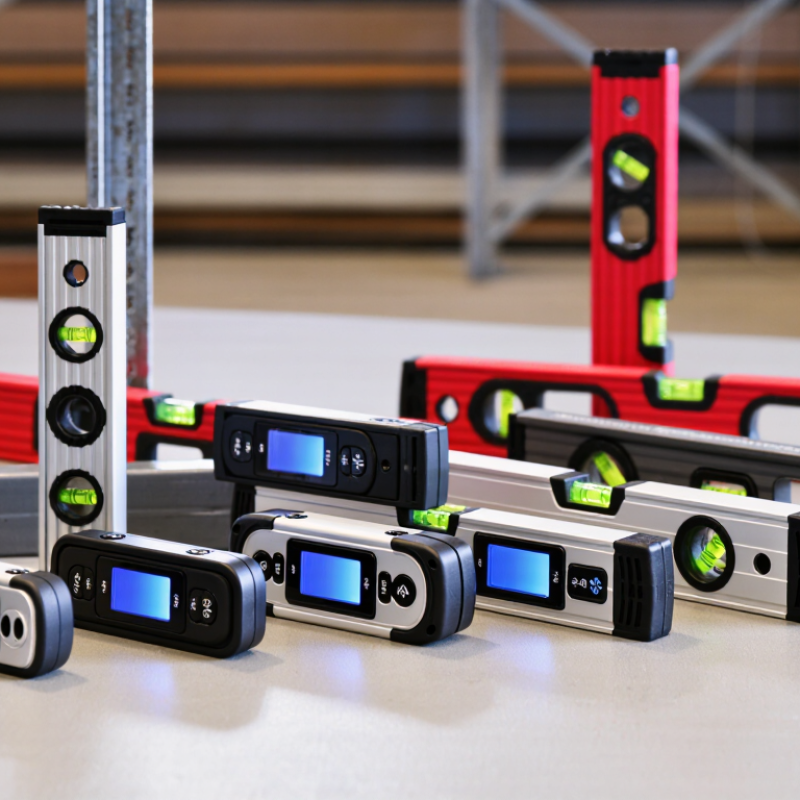
Digital Spirit Level Basics: Accuracy, Resolution, Calibration, and ISO 17123-6
When comparing digital spirit levels for worldwide buyers, begin with accuracy, not screen size or extra functions. Accuracy describes how closely the displayed angle matches the true angle. A level rated at ±0.1° may still show small errors on long installations. Resolution is different. It indicates the smallest displayed change, such as 0.01°. Resolution is not accuracy.
Calibration can drift. Temperature changes, battery condition, impacts, and worn reference surfaces may affect readings. A practical check uses a stable, known-flat surface. Take a reading, rotate the level 180 degrees, and compare the result. The two readings should agree closely. If they do not, follow the instrument’s calibration procedure instead of adjusting by guesswork. I have found that rushed checks often create false confidence, especially when the workpiece itself is uneven.
Buyers should also examine the test documentation and measurement conditions. ISO 17123-6 concerns field procedures for testing rotating lasers, so it should not automatically be treated as a digital spirit level certification. Still, its emphasis on repeatable field testing is useful when judging professional measurement equipment. Ask whether accuracy is stated across the full measuring range, and whether calibration is traceable to recognized references. Water resistance, readable displays, and audible alerts matter on active sites, but they cannot repair poor accuracy. A small, clearly explained limitation is more trustworthy than an impressive specification with no test method.
Top 10 Digital Spirit Levels for Buyers Worldwide? - Digital Spirit Level Basics: Accuracy, Resolution, Calibration, and ISO 17123-6
| Rank | Digital Spirit Level Category | Typical Length | Typical Accuracy at 0°/90° | Display Resolution | Calibration Method | Typical Protection | Best Buyer Use | ISO 17123-6 Relevance |
|---|---|---|---|---|---|---|---|---|
| 1 | Professional Electronic Box Level | 600–1200 mm | ±0.05° to ±0.10° | 0.01° | Two-point check on a stable horizontal reference; rotate 180° and compare readings. | Usually IP54–IP65 | General construction, cabinetry, installations, and repeatable alignment work. | Not directly covered. ISO 17123-6 applies to rotating lasers, not ordinary digital spirit levels. |
| 2 | High-Accuracy Survey Alignment Level | 600–800 mm | ±0.03° to ±0.05° | 0.01° | Calibrate against a verified reference surface and document the before-and-after readings. | Typically IP54 or higher | Precision installation, machine setup, inspection, and controlled indoor alignment. | Use a documented instrument-specific procedure; ISO 17123-6 is not a digital-level accuracy specification. |
| 3 | Compact Professional Digital Level | 300–600 mm | ±0.05° to ±0.10° | 0.01° or 0.1° | Check on a known level surface before use; reverse the instrument to detect offset. | Usually IP54 | Maintenance teams, interior work, furniture installation, and confined spaces. | Outside the scope of ISO 17123-6; follow the supplied calibration instructions. |
| 4 | Heavy-Duty Site Digital Level | 600–1000 mm | ±0.10° | 0.1° | Verify after impact, temperature change, or transport; use a stable reference. | Often IP65 | Masonry, framing, steelwork, outdoor construction, and demanding job sites. | ISO 17123-6 does not define this product category or its calibration requirements. |
| 5 | Magnetic Digital Level | 300–600 mm | ±0.10° | 0.1° | Clean the magnetic base, place it on a verified surface, and compare normal and reversed readings. | Commonly IP54–IP65 | Steel fabrication, HVAC ductwork, pipe fitting, and metal installation. | Not an ISO 17123-6 instrument; magnetic-base flatness must also be checked. |
| 6 | Pocket Digital Level | 100–250 mm | ±0.10° to ±0.20° | 0.1° | Use a repeatable reference block; take several readings and check consistency. | IP54 is common | Quick checks, small assemblies, electronics, furniture, and maintenance kits. | ISO 17123-6 is not applicable to pocket digital levels. |
| 7 | Digital Angle Finder with Level Mode | 150–300 mm | ±0.10° to ±0.20° | 0.1° | Zero on a known reference, then verify at 0°, 90°, and, where supported, 180°. | Varies; often IP54 | Slope measurement, woodworking, roof work, and adjustable-angle components. | ISO 17123-6 concerns rotating lasers, not electronic angle finders. |
| 8 | Long-Range Digital Level with Remote Display | 600–1200 mm | ±0.05° to ±0.10° | 0.01° or 0.1° | Compare the main and remote readings on a stable reference; repeat after wireless pairing. | Typically IP54 | Large panels, long runs, structural installation, and one-person alignment tasks. | No direct ISO 17123-6 classification; remote display does not change the instrument category. |
| 9 | Rechargeable USB Digital Level | 300–600 mm | ±0.10° | 0.1° | Charge fully, allow the unit to stabilize, and verify against a known horizontal surface. | Often IP54 | Mobile work crews, frequent field use, and users who prefer rechargeable power. | Not covered by ISO 17123-6; battery type has no effect on the applicable standard. |
| 10 | Entry-Level DIY Digital Level | 200–600 mm | ±0.20° to ±0.50° | 0.1° | Perform a simple reverse-position check before important work; avoid relying on one reading. | Basic splash resistance varies | Home improvement, picture hanging, shelving, and non-critical alignment. | ISO 17123-6 is not applicable; use only for tasks compatible with its stated accuracy. |
| Buyer note: Accuracy describes closeness to the true angle, while resolution describes the smallest displayed increment. A 0.01° display resolution does not automatically mean ±0.01° accuracy. For critical work, verify the level against a traceable reference and retain calibration records. ISO 17123-6 specifies field procedures for testing rotating lasers; it should not be presented as a certification standard for conventional digital spirit levels. | ||||||||