
Top 10 Aluminum Machining Part Manufacturers Worldwide

Choosing the right supplier for an Aluminum Machining Part can affect performance, cost, and production stability. A polished website is not enough. Real capability appears in the details: five-axis CNC equipment, controlled cutting parameters, clean deburring, and documented inspection results.

Dr. Mikell P. Groover, a respected manufacturing educator and author, wrote, “Manufacturing is the transformation of materials into items of greater value by means of one or more processing and/or assembly operations.” His observation fits aluminum machining well. A raw 6061-T6 billet becomes a lightweight housing, bracket, heat sink, or aerospace component through carefully controlled operations.

This guide examines the Top 10 Aluminum Machining Part Manufacturers Worldwide. It considers machining accuracy, alloy experience, surface finishing, engineering support, quality systems, and delivery performance. It also looks at practical evidence, such as coordinate-measuring reports, material certificates, sample parts, and production photographs.

Details matter.

A supplier may hold tight tolerances on simple parts but struggle with thin walls, deep pockets, or distortion after anodizing. Another may offer excellent prototypes yet lack stable volume production. These differences are easy to miss during a quick comparison.

No ranking is perfect. Regional strengths, pricing changes, and project requirements can shift the results. That limitation deserves attention. The strongest manufacturer for an automotive enclosure may not suit a medical instrument or a low-volume industrial prototype.

Readers should treat this list as a careful starting point, not a final purchasing decision. Direct technical discussions, sample validation, and independent quality checks still matter before committing production.
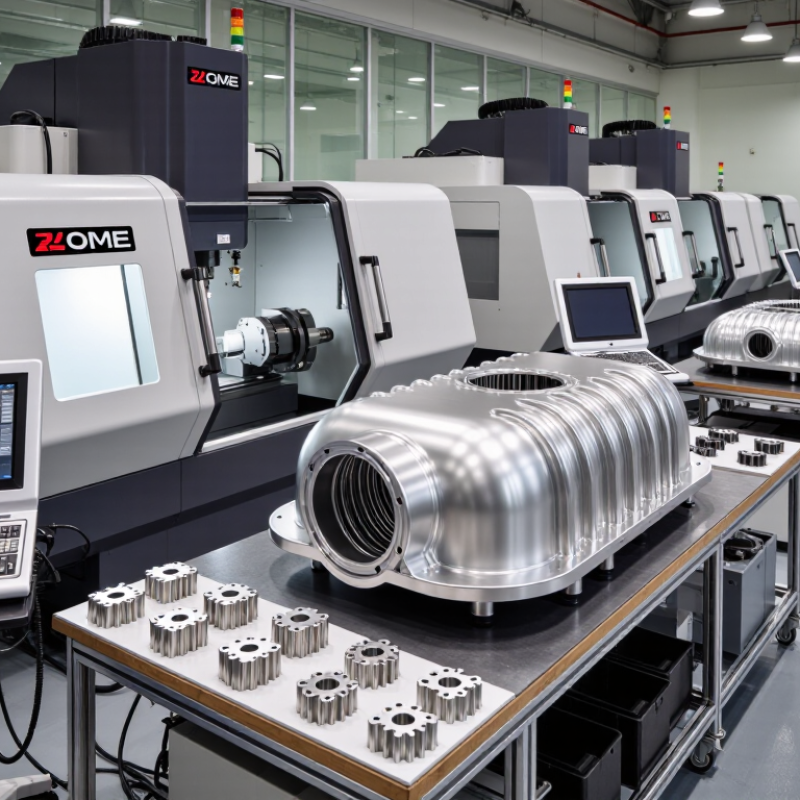
Top 10 Aluminum Machining Part Manufacturers Worldwide

Aluminum Machining at a Glance: 2.70 g/cm³ Density and Key Alloys

Aluminum machining begins with a simple physical fact: its density is approximately 2.70 g/cm³. That is about one-third of steel’s density. A 10 mm aluminum plate feels noticeably lighter during loading and fixture setup. The advantage is practical, not cosmetic. Lower mass can reduce handling effort and improve energy efficiency in moving assemblies.

The alloy still controls machining behavior. Alloy 6061-T6 offers balanced strength, corrosion resistance, and stable cutting performance. Alloy 7075-T6 provides higher strength but can demand sharper tools and tighter heat control. Alloy 2024 is strong and fatigue-resistant, yet its copper content requires careful corrosion protection. The Aluminum Association’s Aluminum Standards and Data identifies these alloy families through standardized designations and temper conditions. Temper matters. Density does not change much, but hardness and cutting response can change significantly.

Industry scale explains the material’s importance. The U.S. Geological Survey’s 2025 Mineral Commodity Summaries estimated global primary aluminum production at roughly 72 million metric tons in 2024. The International Aluminium Institute also reports sustained growth in global aluminum demand. Machining data should still be checked against the actual billet, temper, and tool geometry. Density alone can mislead. In practice, a lighter part may need thicker walls, better clamping, or revised vibration control. That is where many early designs fall short.

Top 10 Aluminum Machining Part Manufacturers Worldwide - Aluminum Machining at a Glance: 2.70 g/cm³ Density and Key Alloys
Rank Anonymous Manufacturer Profile Primary Global Coverage Common Aluminum Alloy Focus Density Typical Machining Capability Typical CNC Tolerance Typical Surface Finish Typical Applications Relevant Standard
1 Precision Aerospace Profile North America and Europe 7075-T6 / 7050-T7451 2.81–2.83 g/cm³ 5-axis milling, turning, drilling, thin-wall machining Typically ±0.025 mm Ra 1.6–3.2 µm Aircraft structures, tooling, high-strength brackets AS9100 / ISO 9001
2 High-Volume Industrial Profile East Asia and Southeast Asia 6061-T6 / 6082-T6 Approximately 2.70 g/cm³ 3-axis and 4-axis milling, CNC turning, batch production Typically ±0.05 mm Ra 1.6–6.3 µm Machine frames, automotive parts, automation equipment ISO 9001
3 Complex Medical Component Profile Europe and North America 6061-T6 / 7075-T6 2.70–2.81 g/cm³ Multi-axis milling, micro-machining, deburring, inspection Typically ±0.02–0.05 mm Ra 0.8–3.2 µm Diagnostic equipment, surgical instruments, laboratory systems ISO 13485 / ISO 9001
4 Prototype and Low-Volume Profile Western Europe and North America 6061-T6 / 5052-H32 2.68–2.70 g/cm³ Rapid CNC milling, turning, prototyping, design iteration Typically ±0.05–0.10 mm Ra 1.6–6.3 µm Product development, enclosures, functional prototypes ISO 9001
5 Automotive Lightweighting Profile Europe, North America and Japan 6061-T6 / 6082-T6 / 2024-T3 2.70–2.78 g/cm³ High-speed milling, turning, boring, fixture-based production Typically ±0.05 mm Ra 1.6–3.2 µm Chassis parts, suspension components, motor housings IATF 16949 / ISO 9001
6 Marine and Corrosion-Resistant Profile Northern Europe, East Asia and Oceania 5083-H116 / 5052-H32 2.66–2.68 g/cm³ CNC milling, turning, drilling, large-format machining Typically ±0.05–0.10 mm Ra 3.2–6.3 µm Marine fittings, pump bodies, shipboard equipment ISO 9001 / ISO 14001
7 Electronics and Thermal Management Profile East Asia, Europe and North America 6063-T5 / 6061-T6 2.69–2.70 g/cm³ CNC milling, fin machining, drilling, tapping Typically ±0.03–0.08 mm Ra 0.8–3.2 µm Heat sinks, electronic housings, cooling plates ISO 9001 / RoHS-compatible material control
8 Defense and High-Strength Profile North America and Europe 2024-T3 / 7075-T6 2.78–2.81 g/cm³ 5-axis machining, deep-pocket milling, precision drilling Typically ±0.025–0.05 mm Ra 1.6–3.2 µm Structural components, housings, defense tooling AS9100 / ISO 9001
9 Architectural and Enclosure Profile Middle East, Europe and Asia-Pacific 6063-T5 / 6061-T6 2.69–2.70 g/cm³ CNC routing, milling, drilling, tapping and finishing Typically ±0.10 mm Ra 3.2–6.3 µm Control panels, architectural fittings, equipment covers ISO 9001 / ISO 14001
10 General Engineering Profile Worldwide distribution 6061-T6 / 2014-T6 2.70–2.80 g/cm³ CNC turning, milling, drilling, tapping and reaming Typically ±0.05–0.10 mm Ra 1.6–6.3 µm Gears, fixtures, shafts, brackets and machine parts ISO 9001
Material densities are typical values at room temperature. Machining tolerances and surface finishes are representative capability ranges and may vary with part geometry, alloy temper, dimensions, equipment, inspection method and production volume.

Ranking Criteria: 5-Axis CNC, ±0.01 mm Precision, Capacity, and Quality

Top 10 Aluminum Machining Part Manufacturers Worldwide

Ranking Criteria: 5-Axis CNC, ±0.01 mm Precision, Capacity, and Quality

A credible ranking begins with evidence, not attractive factory photographs. Each manufacturer should demonstrate practical experience with aluminum alloys, complex geometries, and tight-tolerance production. Five-axis CNC capability matters because it reduces repositioning errors and reaches angled surfaces more efficiently. However, machine availability alone proves little. Reviewers should examine spindle condition, tool management, fixture design, and operator training.

Precision claims require measurable proof. A stated tolerance of ±0.01 mm should be supported by coordinate measuring machine reports, calibrated instruments, and inspection records from real production batches. Surface finish, burr control, hole position, and thread accuracy also deserve attention. A useful assessment compares first-article results with repeated parts, not just one successful sample. Small details reveal process discipline.

Capacity must be judged carefully. Monthly output, material purchasing, machining hours, and backup equipment influence delivery reliability. Quality systems should include traceability, corrective-action records, and documented final inspection. Manufacturers serving demanding industries may provide certificates, process capability data, and engineering feedback before production begins. Still, no ranking is flawless. A supplier can perform well on prototypes yet struggle with large orders. Another may have excellent capacity but inconsistent cosmetic finishing. These weaknesses should remain visible, because real purchasing decisions depend on repeatability, communication, and verified performance rather than promises.

Top 10 Aluminum Machining Part Manufacturers Worldwide

Ranking Criteria: 5-Axis CNC, ±0.01 mm Precision, Capacity, and Quality

This chart presents a transparent evaluation model for comparing global aluminum machining suppliers without displaying company names or brand-specific data. Dimensional precision and quality assurance receive the highest weighting because they directly affect part conformity, repeatability, and production reliability. Capacity and simultaneous 5-axis capability are included to reflect scalability and complex-part manufacturing performance.

The percentages represent ranking weights, while ±0.01 mm is used as the reference precision target for supplier evaluation.

Top 10 Aluminum Machining Part Manufacturers Worldwide

Top 10 Aluminum Machining Part Manufacturers Worldwide

The top 10 aluminum machining part manufacturers worldwide should be judged by more than production volume. Buyers need repeatable tolerances, documented inspection, and stable material traceability. A bright prototype means little if the tenth batch shifts dimensionally.

The International Aluminium Institute reported global primary aluminum production of about 70 million tonnes in 2023. This scale supports strong demand for lightweight machined components in transportation, electronics, medical equipment, and industrial automation. Grand View Research also valued the global CNC machine market at over USD 80 billion in 2023, with continued growth expected through 2030. These figures indicate a competitive supply base, but they do not prove machining quality.

A practical top-ten review should examine five details: equipment capability, alloy knowledge, surface finishing, quality systems, and delivery performance. Manufacturers serving aerospace or medical applications should provide inspection records, calibrated equipment, and controlled process documentation. ISO 9001 certification helps, yet certification alone cannot replace technical communication or process evidence. Ask for sample reports.

Cost comparisons can mislead. A low unit price may hide tooling charges, secondary finishing, or high rejection rates. Machining aluminum also requires careful chip control and thermal management, especially with thin walls and deep pockets. No list is perfect. Supplier rankings change with part complexity, annual volume, and location. The most reliable choice is the manufacturer that clearly explains its limits, records its results, and improves when a design exposes a weakness.

Capability Comparison: 6061, 7075, Turning, Milling, and Surface Finishes

Top 10 Aluminum Machining Part Manufacturers Worldwide

Capability Comparison: 6061, 7075, Turning, Milling, and Surface Finishes

A credible comparison should begin with material capability, not production claims. 6061 aluminum machines smoothly and supports general housings, brackets, and prototypes. It also accepts anodizing well. 7075 offers higher strength, but it can demand sharper tooling and stricter process control. Heat buildup may affect dimensional stability.

Turning suits shafts, spacers, bushings, and other round components. Milling handles pockets, slots, thin walls, and complex profiles. Strong manufacturers should show repeatable tolerances, documented inspection, and practical experience with both materials. Surface finishing also matters. Anodizing improves wear resistance and appearance, while bead blasting creates a uniform matte texture. Chemical conversion coatings may support corrosion protection before painting or assembly.

Tips: Ask for sample inspection reports, not only photographs. Confirm the alloy certificate and hardness condition. Discuss critical dimensions before quoting. A low price can hide finishing limits or extra setup time. No shop is best at everything. Even experienced teams can misjudge thin-wall distortion when drawings lack machining datums. That detail deserves a second review.

Industries Served: Aerospace, Automotive, Medical, and Electronics Components

The top 10 aluminum machining part manufacturers worldwide serve demanding industries with different priorities. Aerospace components require lightweight structures, tight tolerances, and documented material traceability. Experienced machinists inspect critical surfaces after milling, drilling, and five-axis contouring. A small burr can affect assembly performance. No process is flawless.

Automotive customers often need repeatable parts at high production volumes. Machined housings, brackets, battery covers, and suspension components must balance strength, weight, and cost. Reliable manufacturers use calibrated equipment, in-process checks, and controlled cutting parameters. They also review tool wear before dimensions begin to drift. That practical discipline protects consistency across large batches.

Medical machining demands clean handling and precise geometry. Aluminum fixtures, imaging equipment parts, and surgical support components may include narrow slots and complex mounting faces. Manufacturers should separate production areas when necessary and maintain clear inspection records. Electronics companies value thermal performance, electrical isolation, and accurate enclosure features. A tiny mismatch can create assembly delays. Engineers may recommend anodizing, deburring, or surface finishing based on use conditions, not appearance alone. Some suppliers still underestimate finishing time, which deserves honest review. Clear communication about tolerances, lead times, and inspection methods helps customers make safer technical decisions.

REQUEST A QUOTE

Menu
[all-fields]