
How to Choose the Right Bridge Crane for Your Needs?

Choosing the right Bridge Crane begins with the load, not the catalogue. A 10-ton crane may sound sufficient, yet a 9-ton load with a long lifting radius can expose hidden capacity limits. Duty class, span, lift height, travel speed, duty cycles, building clearance, and future production must be examined together. The European Federation of Materials Handling (FEM) classifies crane usage by load spectrum and operating frequency, while CMAA Specification No. 70 links crane classes with expected service conditions. These standards provide structure, but they cannot replace a site survey.

Market research also shows why selection deserves care. Grand View Research estimates continued growth in the global overhead crane market through 2030, driven by manufacturing, logistics, and infrastructure investment. Fortune Business Insights reports similar expansion, although published market values differ because researchers define “overhead crane” differently. That difference is worth remembering. Numbers can guide decisions, but they should not make the decision alone.

Konecranes states that “safety is always our first priority,” a principle repeatedly emphasized by its industry leadership, including CEO Anders Svensson. The practical meaning is clear: choose controls, brakes, runway components, and maintenance access with real operators in mind. A dusty steel mill needs different protection than a clean warehouse. A fast crane is not automatically a productive crane. I have seen specifications look perfect on paper, then fail to account for low headroom or awkward load shapes. That is the uncomfortable lesson. This guide will compare capacity, configuration, safety, lifecycle cost, and supplier support, helping readers select a Bridge Crane that fits actual work—not merely an attractive quotation.
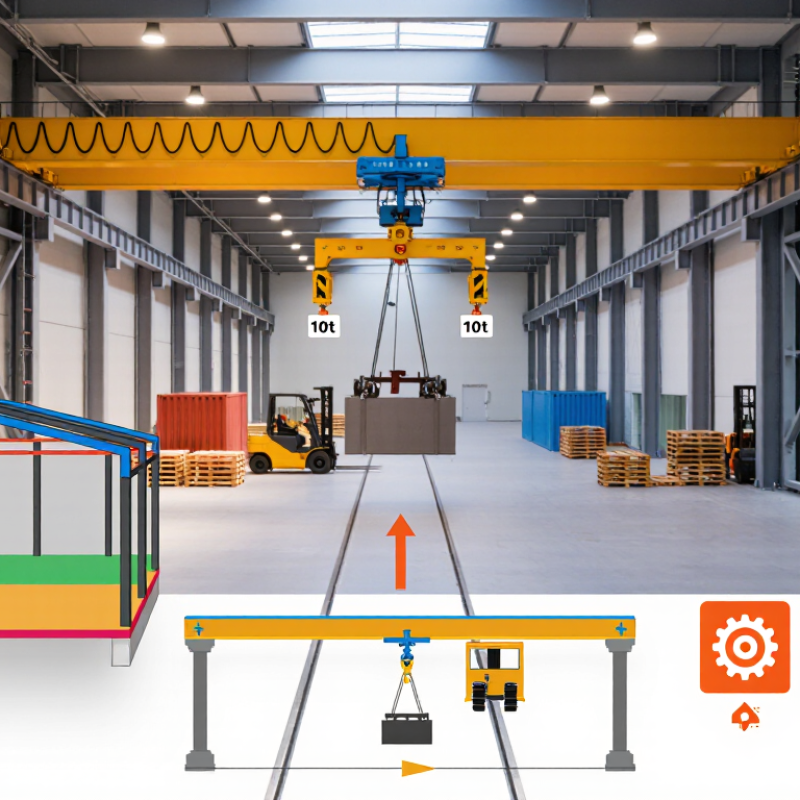
How to Choose the Right Bridge Crane for Your Needs?

Classify the Load: Capacity, Span, Lift Height, and Duty Cycle

Choosing a bridge crane begins with the load profile, not the hook height. Record the heaviest load, average load, lifting frequency, travel distance, span, and required clearance. Rated capacity must cover the heaviest planned load, including lifting devices and impact effects. Do not size from an average shift.

Span changes structural demand. A longer runway can increase beam deflection, wheel loads, and installation cost. Lift height also needs practical measurement. Include the hook’s lowest position, top-of-load clearance, rope reeving, and maintenance access. A 10-meter lift may require more headroom than the drawing suggests. This detail is often missed.

Duty cycle deserves careful attention. CMAA Specification No. 70 defines service classes from A through F, ranging from standby use to continuous severe service. ISO 4301-1 also evaluates utilization and load-spectrum classes. Count starts, stops, lifts, and trolley movements across a typical week. A crane lifting 2 tonnes repeatedly may face more wear than one lifting 8 tonnes occasionally. That comparison is easy to underestimate. ASME B30.2 guidance should support the final engineering review, while site conditions should control the selection. I would challenge any specification based on one busy day; production patterns change, and “occasional” work can become routine.


Match Duty to CMAA Classes A–F and ISO 4301 Utilization Groups

Choosing a bridge crane starts with duty, not rated capacity. A 10-ton crane lifting twice daily faces different demands than one moving loads every five minutes.

CMAA Classes A through F describe service intensity. Class A suits standby work with rare, precise lifts. Class B handles light service and occasional production use. Class C fits moderate duty, such as regular workshop handling. Class D supports heavier cycles, repeated lifts, and more frequent starts. Class E serves severe industrial duty with high daily usage. Class F is intended for continuous, demanding operation where the crane works near its rated capacity.

ISO 4301 adds another useful lens through utilization groups. Its U0–U9 groups reflect expected total working cycles, while load-spectrum categories consider how heavily those cycles load the mechanism. Do not treat a CMAA class and an ISO group as exact equivalents. They measure related, but different, factors. A crane may have moderate cycles yet handle heavy loads, creating a higher mechanism demand than the schedule suggests.

Record the actual work pattern for at least one representative week. Note lift frequency, average load, peak load, travel distance, starts, stops, and idle time. Include heat, dust, outdoor exposure, and operator practices. These details often change the selection. I have seen capacity receive more attention than cycling, and that can be an expensive mistake. When data is uncertain, choose conservatively and ask a qualified crane engineer to verify the classification against ISO 4301 and applicable safety requirements.

How to Choose the Right Bridge Crane for Your Needs? - Match Duty to CMAA Classes A–F and ISO 4301 Utilization Groups

CMAA Class Typical Duty Profile Indicative Operating Pattern Typical Load Spectrum Indicative ISO 4301 Utilization Range Suitable Applications Selection Guidance
A Infrequent or standby service with long idle periods. Occasional lifting; generally not used as part of a continuous production process. Usually light and highly variable loading. Often planned around ISO 4301 groups U0–U2 with Q1–Q2, subject to the actual load spectrum. Maintenance areas, utility facilities, assembly areas, and equipment rooms. Do not select this class solely because the maximum load is low; verify the expected annual cycles and longest periods of inactivity.
B Light service with intermittent handling. Approximately 2–5 lifting cycles per hour, normally with short operating periods. Light loading with occasional lifts near rated capacity. Commonly considered within ISO 4301 U1–U3 and Q1–Q2 planning ranges. Light warehouses, service bays, repair shops, and occasional material handling. Check that starts, stops, travel distance, and load distribution do not exceed the assumed intermittent duty.
C Moderate service for general industrial use. Approximately 5–10 lifting cycles per hour with regular daily use. Moderate loading; rated-capacity lifts occur periodically rather than continuously. Often evaluated within ISO 4301 U2–U4 and Q2–Q3 planning ranges. Machine shops, fabrication facilities, general manufacturing, and process support. A common general-purpose choice, but confirm the required total working cycles and average load spectrum.
D Heavy service with repetitive production handling. Approximately 10–20 lifting cycles per hour and regular operation across the workday. Moderate-to-heavy loading with frequent use of a substantial portion of rated capacity. Often evaluated within ISO 4301 U3–U5 and Q2–Q3 planning ranges. Production lines, steel fabrication, foundry support, and high-use manufacturing areas. Consider higher hoist, motor, brake, wheel, and structural fatigue requirements when production is repetitive.
E Severe service with high production demand. More than approximately 20 lifting cycles per hour, often over multiple shifts. Heavy and frequent loading; a significant share of lifts may approach rated capacity. Often evaluated within ISO 4301 U5–U7 and Q3–Q4 planning ranges. Continuous production, heavy fabrication, material stockyards, and demanding process operations. Use measured or carefully estimated cycle counts, duty-cycle duration, speeds, accelerations, and load history.
F Continuous severe service requiring maximum reliability and durability. Very high utilization, often dedicated to a specific production process and operating for extended periods. Very heavy or highly concentrated loading with frequent near-capacity lifts. Frequently associated with ISO 4301 U6–U9 and Q3–Q4 planning ranges, subject to engineering verification. Specialized process cranes, high-throughput production, heavy-duty transfer operations, and continuous-duty facilities. Require a project-specific fatigue, thermal, mechanical, electrical, and maintenance assessment rather than a generic class selection.

ISO 4301-1 Utilization Reference

ISO 4301 Utilization Group Total Working Cycles, N General Interpretation
U0 N ≤ 16,000 Very low utilization
U1 16,000 < N ≤ 32,000 Low utilization
U2 32,000 < N ≤ 63,000 Low-to-moderate utilization
U3 63,000 < N ≤ 125,000 Moderate utilization
U4 125,000 < N ≤ 250,000 Moderate-to-high utilization
U5 250,000 < N ≤ 500,000 High utilization
U6 500,000 < N ≤ 1,000,000 Very high utilization
U7 1,000,000 < N ≤ 2,000,000 Extremely high utilization
U8 2,000,000 < N ≤ 4,000,000 Exceptionally high utilization
U9 N > 4,000,000 Maximum defined utilization range
Important: CMAA Classes A–F and ISO 4301 utilization groups are not direct one-to-one equivalents. Final crane selection should be based on rated load, load spectrum, total working cycles, operating hours, lift and travel speeds, acceleration frequency, environmental conditions, required design life, and applicable local safety requirements.

Select Single- or Double-Girder Design by Span and Capacity

How to Choose the Right Bridge Crane for Your Needs?

Select Single- or Double-Girder Design by Span and Capacity

A single-girder bridge crane suits lighter loads, moderate spans, and buildings with limited headroom. Many engineering guides place its practical range near 10–20 tonnes and spans up to about 20 metres. These figures are guidelines, not promises. A compact workshop may gain valuable clearance with one girder, while a double-girder crane offers stronger support for heavier loads and wider bays. It also provides more room for high-capacity hoists, walkways, and maintenance access.

Capacity is only one decision point. Measure the runway span, lifting height, duty cycle, load shape, and expected starts per hour. The Crane Manufacturers Association of America classifies crane service from light intermittent use to severe continuous duty in Specification No. 70. A crane lifting five tonnes occasionally may need less structure than one lifting the same load every few minutes. That distinction is often missed.

Check the building before selecting the bridge. The U.S. Occupational Safety and Health Administration requires rated-load markings, regular inspections, and suitable runway construction under 29 CFR 1910.179. The 2024 MarketsandMarkets overhead-crane report forecasts continued market growth through 2029, driven partly by manufacturing and infrastructure investment. Market growth does not justify oversizing every crane. A double-girder design can increase purchase cost, runway loads, and installation complexity. Sometimes, the “stronger” choice is inefficient. Have a qualified engineer verify wheel loads, deflection, seismic conditions, and actual production duty before approval.

Verify Runway Loads, Deflection Limits, and ASME B30.2 Compliance

Choosing a bridge crane starts with the building, not the hoist. Request the runway beam reactions, wheel loads, and maximum trolley position from the crane engineer. Then compare them with the supporting structure’s design capacity.

The U.S. Bureau of Labor Statistics recorded 1,069 workplace fatalities involving contact with objects or equipment in 2023. That broad category is not crane-specific, but it shows why load verification cannot be treated as paperwork.

Check vertical reactions, lateral forces, impact effects, and fatigue cycles. A 10-ton rated load can produce much higher local wheel forces during acceleration or skewing.

Deflection also matters. Excessive runway movement may cause poor wheel tracking, noisy operation, and faster rail wear.

ASCE 7 load combinations and AISC steel design guidance can support the structural review, while project specifications should define the acceptable deflection limit.

There is no universal number for every crane installation. That is where mistakes happen.

Confirm the selected equipment against ASME B30.2 requirements for overhead and gantry cranes.

Review rated-load markings, controls, inspections, maintenance access, and operating procedures with a qualified professional.

Keep the calculation package, inspection records, and field measurements together.

During commissioning, measure unloaded and loaded behavior at several runway points. Real buildings rarely match drawings perfectly. A small alignment error can become a costly operating problem.

Compare Controls, Safety Systems, Maintenance, and Total Cost of Ownership

How to Choose the Right Bridge Crane for Your Needs?

Controls should match the operator, load, and workspace. A pendant control may suit a short bay, while radio control improves visibility around large loads. Variable-speed travel can reduce swinging and positioning errors. Add overload protection, emergency stops, limit switches, and anti-collision devices where traffic is complex.

The U.S. Bureau of Labor Statistics reported 5,283 fatal workplace injuries in 2023, with a rate of 3.5 deaths per 100,000 full-time workers.

A crane is not automatically safe because it is new. Training and daily behavior matter more than many buyers admit.

Maintenance affects the real purchase price. OSHA 29 CFR 1910.179 calls for frequent inspections from daily to monthly intervals, plus periodic inspections from one to twelve months. Choose equipment with accessible brakes, sealed electrical components, clear fault codes, and locally available spare parts. Keep inspection records beside the control cabinet.

Small delays become expensive. The total cost of ownership includes electricity, operator training, scheduled service, replacement parts, downtime, and production losses. Compare those costs over ten years, not only the quotation.

A lower-cost crane may require more manual checks and longer repairs. That is a detail I would challenge before signing.

Industry guidance, including FEM crane classification practices, also links duty cycles with structural and mechanical life. Estimate real lifting frequency honestly; optimistic figures can distort the entire decision.

REQUEST A QUOTE

Menu
[all-fields]