How to Choose the Best Anchor Drill Rig?
Choosing the best Anchor Drill Rig starts with the ground, not the brochure. A rig that performs well in fractured rock may struggle in loose soil or mixed layers. Identify the expected geology, drilling diameter, anchor depth, and daily workload before comparing models. Small details matter. A narrow access road, low overhead clearance, or muddy platform can rule out an otherwise capable machine.
Look closely at drilling capacity, torque, feed force, mast reach, and available tooling. Match these specifications to your project rather than choosing the largest rig by default. For example, a compact rig may suit a hillside site where transport and setup space are limited. On a larger job, faster cycle times and longer operating shifts may carry more weight. Ask suppliers for comparable performance data and practical demonstrations in similar ground conditions. Numbers on paper do not tell the whole story.
Operator visibility, control layout, maintenance access, and parts availability also affect results. Check how routine service is performed, how quickly common wear parts can be replaced, and whether local technicians can support the equipment. Safety features deserve careful review, including stable setup and clear emergency controls. No single model is best for every site. It is easy to overvalue raw power; I have seen that choice create unnecessary transport and operating costs. A careful comparison should balance ground conditions, productivity, budget, and support, while leaving room for an honest uncertainty: actual drilling performance can change with geology and operator experience.
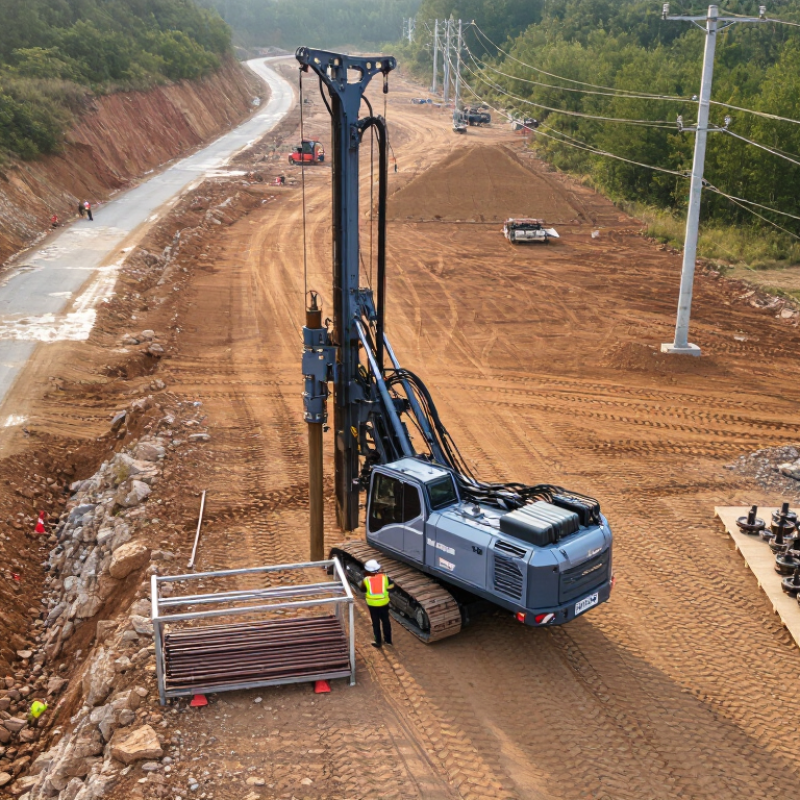
Define the Ground Conditions and Drilling Requirements
Before comparing anchor drill rigs, define what lies below the platform. Review borehole logs for soil layers, weathered rock, groundwater, and loose cobbles; these conditions affect bit choice, flushing, and whether temporary casing is needed. Note the required hole diameter, depth, inclination, and anchor layout. A rig that reaches the target depth may still lack the torque or feed force needed for a stable hole.
For rock sites, use core data rather than visual impressions alone. Deere’s 1963 rock-quality designation (RQD) classification rates 0–25% as very poor, 25–50% poor, 50–75% fair, 75–90% good, and 90–100% excellent. RQD measures core pieces at least 100 mm long, but it does not describe every fracture or weak seam. The FHWA’s Ground Anchors and Anchored Systems guidance also emphasizes matching drilling methods to subsurface conditions. Check whether the proposed rig supports rotary, percussion, or combined drilling, and whether it can manage water or unstable ground.
A tidy log can still miss a hard lens between boreholes. This matters. Compare nearby investigation records with site observations, and flag uncertainty before specifying equipment. For example, wet silty soil may call for casing and controlled flushing, while fractured rock may require a different bit and careful hole cleaning. Confirm access width, overhead clearance, and setup space too; a powerful rig is not useful if it cannot be positioned safely.
Assess Rig Capacity, Reach, and Operating Performance
A useful anchor drill rig comparison starts with the ground, not the brochure. Check required hole diameter, drilling method, anchor length, and the hardest expected layer. Then compare mast reach and angle with the actual working platform. A rig that reaches the target on level ground may struggle beside a wall, under overhead services, or on a narrow bench. Measure clearance and setup space on site. Small details matter.
Capacity needs a careful definition. Confirm torque, feed force, pullback, and compatible rod sizes against the project’s drilling plan; do not treat one headline figure as proof of suitability. FHWA’s Ground Anchors and Anchored Systems manual (1999) specifies test loads of 1.33 times design load for proof tests and 1.50 times design load for performance tests. These figures apply to anchor testing, not a drill rig’s rated pullback. Still, they help teams coordinate drilling equipment with the separate stressing system. That distinction is easy to miss.
Operating performance shows up in the shift log. Track completed hole length, setup time, rod changes, and downtime, rather than relying on a claimed metres-per-hour rate. Check how quickly the rig can be repositioned, whether controls allow precise alignment, and how dust or water is managed. I would verify these points during a site trial; tidy specifications can flatter a machine. A little skepticism helps.
How to Choose the Best Anchor Drill Rig? - Assess Rig Capacity, Reach, and Operating Performance
| Selection Factor | Compact Rig | Mid-Size Rig | Heavy-Duty Rig |
| Typical project fit | Restricted-access sites, slope stabilization, and light-to-medium anchoring work | General-purpose ground anchors, retaining walls, and mixed site conditions | Large infrastructure projects, deep anchoring, and demanding ground conditions |
| Rotary torque (indicative) | 4–8 kN·m | 8–15 kN·m | 15–30 kN·m |
| Feed force (indicative) | 20–40 kN | 40–80 kN | 80–160 kN |
| Pullback force (indicative) | 25–50 kN | 50–100 kN | 100–200 kN |
| Common drilling diameter range | 76–152 mm | 89–203 mm | 114–300 mm |
| Usable feed stroke per setup | About 1.8–3.0 m | About 2.4–4.0 m | About 3.0–6.0 m |
| Typical rotary speed range | 0–150 rpm | 0–120 rpm | 0–100 rpm |
| Approximate operating mass | 6–12 t | 12–25 t | 25–45 t |
| Access and setup considerations | Usually easier to transport and position in confined or low-clearance areas; confirm working envelope and ground-bearing limits. | Balances transport needs with higher capacity; check platform width, mast clearance, and stabilizer requirements. | Requires more space and stronger access routes; verify lifting, transport, platform, and setup requirements before mobilization. |
| Reach and depth planning | Best where the required hole length can be achieved with the available mast stroke, rod changes, and site positioning. | Suitable for a broader range of hole lengths; confirm the planned drilling sequence and any casing or rod-handling limits. | Offers greater capacity for long or large-diameter holes, but actual reach depends on tooling, mast geometry, and ground conditions. |
| Operating performance to compare | Prioritize maneuverability, setup time, and reliable drilling in the expected ground. | Compare sustained torque, feed control, rod handling, and fuel or power use over a typical shift. | Assess performance under continuous high load, cooling capacity, tooling compatibility, and maintenance access. |
| Key checks before selection | Confirm required hole diameter, access width, overhead clearance, and anchor design loads. | Match torque and thrust to the drilling method, ground profile, hole length, and production schedule. | Check that the site can support the rig and that the higher capacity is needed for the specified work. |
Planning note: Figures are indicative ranges for comparing rig classes, not specifications for a particular machine. Actual capacity and production vary with rig configuration, drilling method, tooling, operator, geology, water conditions, and site access. Confirm project requirements and the selected rig’s technical documentation before mobilization.
Check Safety Features, Maintenance, and Technical Support
How to Choose the Best Anchor Drill Rig?
Check Safety Features, Maintenance, and Technical Support
A rig’s drilling speed means little if its safety systems are hard to inspect. Check that emergency stops are accessible and clearly marked. Ask how guards, interlocks, and pressure controls work, then confirm they can be tested before operation. On uneven ground, a stable setup and clear operator visibility matter. Small details matter.
Maintenance needs should fit the crew’s actual routine. Ask for the service schedule and inspect common wear points, such as hoses, filters, and hydraulic fittings. Look for accessible inspection panels and clear instructions for daily checks. A sample log can show how to record leaks, unusual vibration, or loose connections. Follow the maker’s maintenance guidance; service intervals vary with workload and site conditions. It is easy to underestimate the time these checks take.
Technical support is part of the equipment decision, not an afterthought. Ask who handles troubleshooting, what information they need, and how replacement parts are sourced. A useful support team can explain a fault clearly and help operators identify safe next steps. Ask about training, too. Fast answers matter. Still, no support line replaces sound site procedures or a qualified technician for complex repairs. Before buying, compare the support promises with the team’s real needs, including remote locations and planned downtime.
How to Choose the Best Anchor Drill Rig
Compare safety features, maintenance requirements, and technical support before making a selection.
Suggested evaluation weights for a buyer’s comparison rubric—not measured industry statistics. Adjust them to suit your site conditions, operating requirements, and local regulations.
Compare Total Ownership Costs Before Selecting a Rig
A rig with a low purchase price can still cost more over five years. Compare the full ownership picture, not the quote alone. Include financing, fuel, routine service, wear parts, transport, and operator hours. Use service records from similar jobs where possible. A daily log of engine hours, fuel use, and bit changes makes estimates less speculative. Small details matter.
Estimate cost per drilled meter, then test the numbers against your expected ground conditions and production schedule. Ask how often filters, hoses, and drilling tools need replacement in comparable work. A rig that drills quickly in ideal rock may lose that advantage in fractured ground or on frequent moves. Downtime hurts. Include realistic repair delays and the cost of keeping a backup plan; these are easy to overlook when comparing brochures.
Check what maintenance can be done on site, how quickly common parts are available, and whether your crew needs extra training. These factors affect both labor costs and lost production. Resale value matters too, but treat it as an estimate, not a promise. I would revisit the calculation after a few months of use: actual fuel use or wear can differ from the forecast, and that difference may change which rig looks economical.