

- 713.590.1312
- sale@pandbtools.com
China Top 10 Thread Rod Manufacturers for Global Buyers
Selecting reliable Thread Rod suppliers in China requires more than comparing catalogue prices. Global buyers must examine steel grades, thread accuracy, surface treatment, production capacity, and export experience. A polished website proves little. Factory evidence matters more.
This guide introduces ten China-based Thread Rod manufacturers for international purchasing teams. It focuses on practical buying factors, including material certificates, dimensional inspection, packaging quality, and response speed. Sample testing remains essential. A supplier should provide clear drawings, tolerances, coating details, and traceable inspection records. Buyers should also confirm whether production matches standards such as ASTM, DIN, or ISO requirements.
Details matter. Clean threads reduce installation problems. Strong cartons protect rods from bending during ocean transport. Clear labeling supports faster warehouse checks. Experienced manufacturers often explain these points before receiving a purchase order. That is a useful signal.
However, no ranking stays perfect. Product quality can change between batches, and factory capabilities may vary by order size. Some companies use trading partners, while others control production directly. This difference deserves careful verification. Buyers should request recent samples, audit reports, and references from similar markets. Independent inspection can add confidence before shipment.
The selected manufacturers are discussed from a global buyer’s perspective. Their strengths, limitations, production focus, and communication practices receive equal attention. Price is included, but it is not treated as the final answer. A dependable Thread Rod partner should deliver consistent performance, honest documentation, and practical support after the sale. That standard is demanding. It should be.
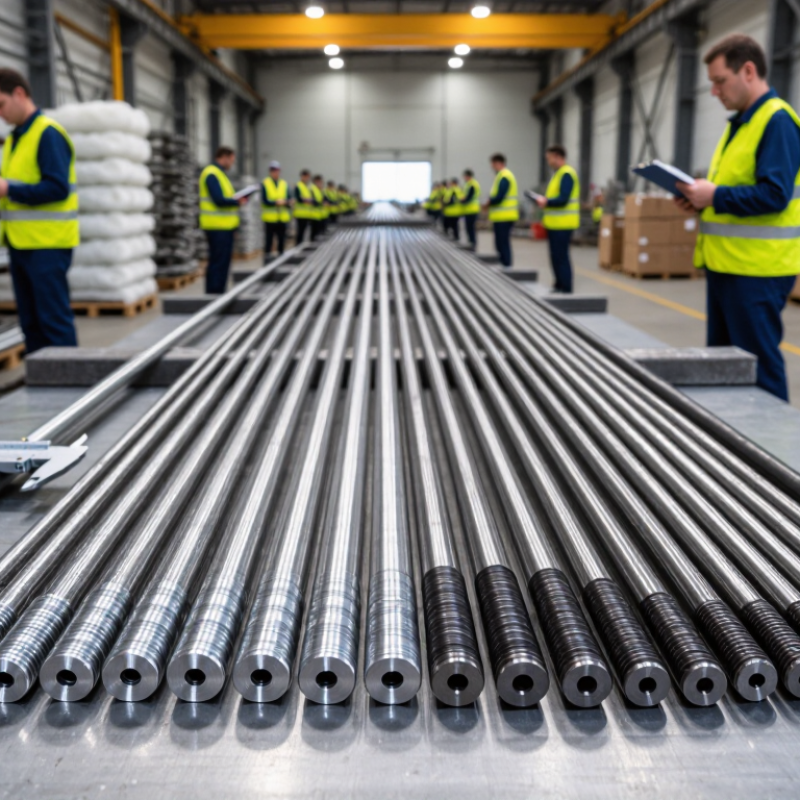
Thread Rod Manufacturing in China: Industry Scope and Product Types
China’s thread rod manufacturing sector sits inside the wider steel fastener industry. The World Steel Association reported 1,019.1 million tonnes of Chinese crude steel production in 2023. That represented roughly 54% of global output. This raw-material depth supports large production capacity and flexible export supply.
However, steel volume does not automatically prove thread rod quality.
Manufacturers commonly produce fully threaded rods, double-end studs, and cut-length threaded bars. Carbon steel suits general construction and equipment assembly. Stainless steel performs better in humid, coastal, or chemically exposed environments. Alloy steel supports higher-temperature and higher-load applications.
Common specifications include metric and imperial diameters, coarse or fine threads, and grades aligned with ISO, ASTM, or DIN requirements. Thread pitch matters. Small errors can stop installation.
Production usually includes wire drawing, straightening, thread rolling or cutting, heat treatment, surface finishing, and final inspection. Thread rolling can improve surface strength and production speed, while cutting remains useful for special sizes. Inspection should cover diameter, pitch, straightness, hardness, coating thickness, and tensile performance.
The China Fastener Industry Association has repeatedly emphasized quality upgrading and standardization in industry discussions. Public market reports often group thread rods with broader fastener categories, so their revenue figures require careful interpretation.
That limitation deserves attention. A supplier with impressive output may still need closer checks on batch traceability, packaging, and test documentation.

How to Evaluate China’s Top 10 Thread Rod Manufacturers
China Top 10 Thread Rod Manufacturers for Global Buyers
Evaluating China’s top 10 thread rod manufacturers requires more than comparing prices. According to the World Steel Association, China produced about 1.019 billion tonnes of crude steel in 2023. This large supply base supports production capacity, but it does not prove consistent thread rod quality. Buyers should verify factory audits, monthly output, raw material sources, and export experience. Capacity figures can be inflated.
Request material certificates for each production lot. Check tensile strength, yield strength, elongation, thread accuracy, and surface finish. ISO 898-1 provides widely used mechanical property requirements for carbon and alloy steel fasteners. For structural applications, ASTM F1554 may also apply. Independent laboratory testing should confirm the manufacturer’s claims. One sample is not enough.
Use a weighted scorecard for the ten candidates. Give quality control and traceability the highest scores, followed by delivery reliability, coating performance, and technical support. Review at least three recent orders, not only showroom samples. Inspect packaging closely: separated bundles, dry wrapping, visible heat numbers, and readable labels reduce receiving errors. A low quotation may hide extra inspection, rework, or replacement costs. I would also question perfect audit results. Real factories sometimes show minor defects; their response reveals more than polished presentations. (World Steel Association, 2024; ISO 898-1; ASTM F1554)
China Top 10 Thread Rod Manufacturers for Global Buyers - How to Evaluate China’s Top 10 Thread Rod Manufacturers
| Evaluation Rank | Evaluation Dimension | Recommended Weight | Objective Industry Data or Benchmark | What Global Buyers Should Verify | Practical Scoring Guide |
|---|---|---|---|---|---|
| 1 | Material Grade and Mechanical Performance | 18% | Common international grades include ASTM A307 Grade A with a minimum tensile strength of 60 ksi, ASTM F1554 Grade 36 with a minimum yield strength of 36 ksi, and ISO 898-1 property classes 8.8 and 10.9 with nominal tensile strengths of 800 MPa and 1,000 MPa respectively. | Confirm the material designation, heat number, mill test certificate, tensile strength, yield strength, elongation, and hardness for each production lot. | 5 points: complete traceability and test results match the specified standard; 3 points: partial documentation; 1 point: unsupported material claims. |
| 2 | Thread Accuracy and Dimensional Control | 15% | Metric threads are commonly specified under ISO 965-1, while unified inch threads use UNC or UNF profiles. Thread fit depends on the declared tolerance class, such as 6g for external metric threads and the applicable unified thread class. | Request thread plug and ring gauge records, pitch-diameter measurements, major and minor diameter data, straightness results, and inspection frequency. | 5 points: documented gauge control and dimensional reports for every lot; 3 points: sampling records only; 1 point: visual inspection only. |
| 3 | Surface Protection and Corrosion Resistance | 12% | Typical finishes include plain steel, electroplated zinc, hot-dip galvanized coating, and stainless steel. ASTM A153 specifies hot-dip galvanized coating requirements for hardware, with coating thickness dependent on the material category and diameter. | Verify coating type, coating thickness, adhesion, salt-spray or cyclic-corrosion results where required, chromate or passivation details, and environmental suitability. | 5 points: finish and test method are clearly specified; 3 points: finish is documented but testing is limited; 1 point: finish is described only by color. |
| 4 | Manufacturing Process and Capacity | 11% | Thread rods may be produced by cold forming, hot forging, or machining, depending on diameter, material, thread length, and required mechanical performance. Production capacity should be assessed against the buyer’s monthly demand and required lead time. | Review equipment lists, process flow charts, monthly output, raw-material storage, bottleneck operations, maintenance records, and capacity during peak seasons. | 5 points: stable process with documented capacity reserves; 3 points: capacity meets current demand only; 1 point: capacity is not verifiable. |
| 5 | Quality Management and Inspection System | 10% | ISO 9001 is a widely used quality-management framework. A robust fastener inspection program normally covers incoming material, forming, thread dimensions, surface finish, mechanical properties, packaging, and final release. | Check certificate validity, inspection plans, calibration records, nonconformance reports, corrective-action procedures, and independent audit results. | 5 points: certified system supported by recent records; 3 points: internal controls are present but limited; 1 point: no formal system evidence. |
| 6 | Product Range and Customization Capability | 9% | A commercially useful range may include metric and inch threads, coarse and fine pitches, full-thread and partial-thread configurations, multiple diameters, cut-to-length options, chamfered ends, and special finishes. | Compare available diameters, standard lengths, thread profiles, tolerances, packaging options, custom drawings, minimum order quantities, and tooling charges. | 5 points: broad standard range plus controlled customization; 3 points: standard products only; 1 point: limited or unclear capability. |
| 7 | Testing, Traceability, and Technical Documentation | 8% | Useful documentation includes drawings, inspection reports, material certificates, coating reports, dimensional records, certificates of conformity, and packaging specifications. Traceability should connect the finished batch to its raw material heat. | Ask for anonymized sample documents, batch-number examples, retention periods, laboratory qualifications, and the procedure for handling customer complaints. | 5 points: complete batch-level documentation; 3 points: documents are available only on request; 1 point: records are inconsistent. |
| 8 | Export Experience and Packaging Control | 7% | Threaded products require packaging that prevents tangling, thread damage, corrosion, moisture exposure, and length or diameter mixing during transport and storage. | Verify export packaging specifications, moisture protection, palletization, carton markings, barcode or label capability, loading photos, and container utilization. | 5 points: packaging is tested and shipment-ready; 3 points: basic packaging is available; 1 point: packaging is undefined. |
| 9 | Lead Time, Delivery Reliability, and Supply Continuity | 6% | Delivery performance should be measured using confirmed production lead time, inspection time, export documentation time, transit planning, and the supplier’s historical on-time delivery rate rather than a single quoted date. | Request a production schedule, capacity reservation procedure, typical lead-time range, backup raw-material sources, and a written escalation process for delays. | 5 points: measurable delivery history and contingency planning; 3 points: delivery dates are estimated; 1 point: no performance data. |
| 10 | Total Cost, Compliance, and After-Sales Support | 4% | Total landed cost includes product price, tooling, testing, packaging, inland transport, export handling, freight, duties, inspection, and the cost of potential nonconformities. Compliance requirements vary by destination and application. | Compare quotations on the same specification, Incoterm, quantity, test plan, packaging basis, payment terms, warranty terms, and replacement or corrective-action procedure. | 5 points: transparent quotation and responsive technical support; 3 points: acceptable price but incomplete cost details; 1 point: price is the only clear input. |
Company Profiles of the Top 10 Chinese Thread Rod Manufacturers
This company profile review examines ten Chinese thread rod manufacturers through practical buyer criteria. Each profile considers production capacity, material control, machining accuracy, export experience, and quality documentation.
Profile one focuses on high-volume carbon steel rods for construction projects. Profile two serves stainless steel orders for humid and coastal environments. Profile three specializes in custom lengths and partial threading.
Profile four combines cold forming with automated thread rolling. The results can be consistent.
Profile five offers galvanized rods with improved surface protection and traceable batch records. Profile six is better suited to small and medium purchase orders. Profile seven supports metric and imperial thread specifications, but buyers should confirm gauge compatibility.
Profile eight emphasizes heavy-duty rods for industrial equipment and structural connections. Profile nine provides packaging designed to prevent thread damage during long-distance transport.
Profile ten combines inspection reports with contract manufacturing services. Its lead times still require careful checking.
Across these profiles, reliable manufacturers should explain steel grades, tensile requirements, thread tolerances, coating thickness, and inspection methods.
Experienced suppliers usually provide samples before large production. They also clarify whether testing is performed internally or by an independent laboratory. Buyers should request mill certificates, dimensional records, and clear photographs of finished bundles.
Catalog language can sound impressive. Factory verification remains necessary. Some manufacturers may have excellent machinery but limited communication during design changes. Others may offer low prices while providing less flexible packaging. These weaknesses deserve honest attention before purchase.
Comparing Materials, Standards, Finishes, and Production Capabilities
China’s top thread rod manufacturers serve global buyers through varied materials, standards, finishes, and production methods. Carbon steel rods suit general fastening and structural work. Alloy steel performs better under higher loads and temperatures. Stainless steel, especially 304 or 316, offers stronger corrosion resistance in wet or coastal environments.
Standards must match the application, not just the quotation. Common references include ASTM, DIN, ISO, and BS specifications. Buyers should verify diameter tolerance, thread pitch, tensile strength, hardness, and chemical composition. Surface options include plain, zinc-plated, hot-dip galvanized, and specialized coatings. Hot-dip galvanizing gives thicker protection, but thread dimensions may change slightly. Cold rolling can improve thread consistency, while cutting and rolling capacity affects length accuracy. A dependable factory should provide mill certificates, inspection records, sample measurements, and traceable batch numbers. Production photos help, but they are not proof alone.
Tips: Request samples before bulk production. Check thread engagement with matching nuts. Ask how coatings are tested after processing. Confirm packaging for long rods; bent threads create expensive delays. I once underestimated packaging quality, and several ends arrived damaged. The factory corrected it, but the lesson remained. A clean sample can still hide weak process control. Buyers should compare inspection evidence, not only price. Some specifications also need clarification, especially when drawings and standards conflict. That uncomfortable discussion is often necessary.
Thread Rod Material and Standard Strength Benchmark
This chart compares commonly specified thread rod grades used by global buyers. Values represent minimum tensile strength for ASTM grades and nominal tensile strength for ISO property classes. The benchmark does not rank individual manufacturers or brands.
Reference standards: ASTM A307, ASTM F1554, ASTM A193, ASTM A354, and ISO 898-1. Actual product availability, diameter range, heat treatment, coating, certification, and inspection capability may vary by supplier.
Global Buyer Guide to Sourcing Thread Rods from China
Sourcing thread rods from China requires more than comparing factory prices. Global buyers should verify material grade, diameter tolerance, thread accuracy, coating, and production capacity before requesting quotations. Ask for mill certificates, inspection records, and clear samples. A reliable supplier can explain whether rods use carbon steel, stainless steel, or alloy steel. Each option suits different loads, corrosion risks, and temperatures. Request drawings showing thread pitch, length, chamfer details, and packing requirements. Small details matter. One overlooked pitch difference can stop assembly on site.
When reviewing China’s top 10 thread rod manufacturers, use the same checklist for every candidate. Compare export experience, response quality, quality-control staff, testing equipment, and traceability from raw material to carton. Confirm lead time, minimum order quantity, payment terms, and pre-shipment inspection arrangements in writing. A video factory audit may reveal storage conditions, cutting methods, and label control. It cannot replace independent inspection. In practice, attractive samples can hide inconsistent batch quality. This deserves reflection. Start with a trial order, record defect rates, and test rods under intended installation conditions. Do not select the lowest quote automatically; a cheaper rod may create higher labor, replacement, and downtime costs.