

- 713.590.1312
- sale@pandbtools.com
Best NFC Smart Door Lock Supplier in China
Choosing the Best NFC Smart Door Lock Supplier in China requires more than comparing prices or polished product photos. Buyers should examine NFC compatibility, credential security, production consistency, and after-sales support. A reliable supplier can explain which phones and cards work, how access permissions are managed, and what happens when batteries run low. Ask for product specifications, sample units, and relevant test documentation. Then compare those details against your project’s door type and software needs.
NFC access-control specialist Alex Chen puts it simply: “A smart lock earns trust through reliable access, clear fallback options, and security that can be verified.” That is the standard this guide applies when reviewing suppliers. Look closely at the reader’s response on a real door, not only in a presentation. Check whether the lock records access events, supports practical administrator controls, and offers mechanical or backup-power access. Small details matter. A reader that struggles through a thick phone case can frustrate users every day.
Manufacturing experience also deserves careful attention. Ask about quality checks, component sourcing, customization limits, and support for firmware updates. Request a clear warranty and a named contact for technical questions. A low quote may hide costly integration work. Sometimes, specifications remain vague until late in the discussion. Treat that as a reason to ask more questions, not as proof of poor quality. This introduction sets out a practical way to assess Chinese suppliers and identify an NFC Smart Door Lock suited to your building, users, and operating conditions.
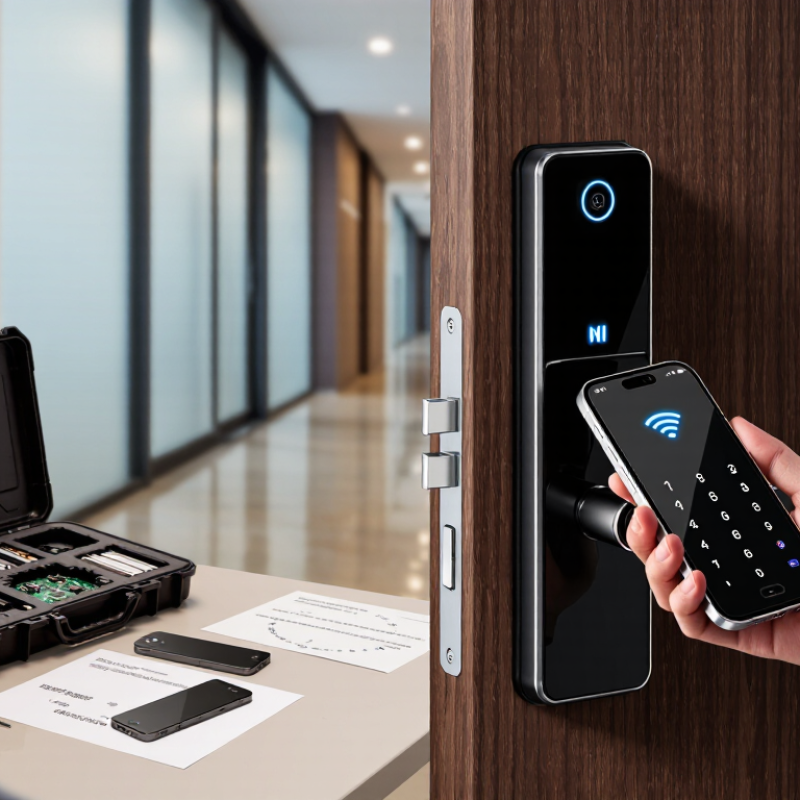
NFC Smart Door Locks: Definition and Core Functions
An NFC smart door lock uses near-field communication to identify a compatible card, tag, or phone held close to its reader. The exchange usually takes place within a few centimeters. Unlike a remote app command, NFC access requires someone to be near the door. That matters.
Core functions include credential reading, access authorization, and locking or unlocking the mechanism. Depending on the model, an administrator may add or remove credentials, assign access periods, and review entry records. A practical test is simple: hold the credential near the reader and check how quickly the latch responds. Some systems also support app management, but NFC itself does not require an internet connection.
For buyers comparing suppliers in China, ask how credentials are stored and managed, what happens when batteries run low, and whether a mechanical key or other fallback is available. Request clear test results for reader response and repeated use. Details vary by design. NFC is convenient, but it is not magic; installation quality, door alignment, and user setup affect daily performance. A rushed setup can leave an authorized card unread, so instructions and support deserve attention too.

How NFC Technology Enables Secure Door Access
NFC door access works through a short-range exchange between a credential and the lock’s reader. A resident holds a compatible card or phone near the handle. The lock checks the credential before releasing the bolt. It takes a moment. The brief range helps reduce accidental reads, but it does not guarantee security by itself.
Protection depends on how credentials are stored, authenticated, and managed. Ask a supplier for clear details on encryption, access permissions, firmware updates, and lost-card handling. A well-designed system lets an administrator revoke one credential without changing every user’s access. Test the reader with the phone cases and cards people actually use. Metal surfaces, reader placement, and installation quality can affect performance.
For buyers comparing NFC smart door locks from suppliers in China, request test records and installation guidance, not just a feature list. Check how the lock behaves when batteries run low and whether a mechanical or other approved backup is available. Still, NFC is not magic. A rushed setup or shared credential can weaken a sound design, and real-world access logs deserve careful review. Ask for a sample unit and assess the reader response, app controls, and documentation before placing a larger order.
| Evaluation Dimension | Technical Detail | Security or Supplier Check |
|---|---|---|
| NFC operating frequency | NFC devices communicate at 13.56 MHz, the frequency used by common NFC and contactless-card systems. | Ask which NFC card or credential types the lock supports; frequency alone does not confirm compatibility. |
| Typical read distance | NFC access is generally intended for close-range use—typically a few centimeters. Actual performance depends on the reader antenna, credential, mounting, and surroundings. | Request a test using the intended cards or phones, installed in a representative door and reader position. |
| Standards and credential compatibility | NFC and contactless credentials may use different standards and card technologies, including ISO/IEC 14443-based products. Compatibility is not universal. | Obtain the supported standards, card types, and mobile-device requirements in writing before ordering. |
| Credential authentication | Some systems authenticate a credential cryptographically; simpler systems may rely on a card identifier. These approaches provide different levels of protection. | Prefer documented cryptographic authentication over access decisions based only on a readable, static card identifier. |
| Encryption and key management | Encryption and mutual authentication depend on the lock, credential, and system design; NFC by itself does not guarantee encrypted communication. | Ask which cryptographic methods are implemented, how keys are provisioned and updated, and whether keys are unique per project or credential. |
| Replay and cloning resistance | Protection varies by credential technology and implementation. A static identifier can be copied more easily than a credential using secure cryptographic challenge-response. | Request technical documentation or independent test evidence for anti-cloning and replay protections; do not rely on “NFC” as a security claim by itself. |
| Lost or revoked credentials | Credential revocation may be handled locally at the lock, through a connected controller, or by a cloud-managed system. | Confirm how quickly a lost credential can be disabled and what happens when the lock is offline. |
| Mobile-phone access | Phone-based NFC access requires compatible phone hardware, operating-system support, and an appropriate credential or application. Not every NFC lock supports phone access. | Test the exact phone models and operating systems required for the project, including the enrollment and recovery process. |
| Power and emergency entry | Electronic locks require a power source. Battery life depends on the lock design, battery type, usage, and environmental conditions. | Check low-battery alerts, battery replacement instructions, and the documented emergency-entry method. Keep emergency access separate from routine NFC credentials. |
| Offline operation | Some locks can validate stored credentials without a network connection; network-dependent features may be unavailable while offline. | Clarify which functions work offline, how access changes are synchronized, and whether audit records are retained locally. |
| Privacy and access logs | Connected access systems may store credential identifiers, event times, and door activity. Data collection and retention vary by product configuration. | Ask what data is collected, where it is stored, who can access it, and how long logs are retained or deleted. |
| Supplier verification | Product capability, quality controls, and certification status must be verified for the specific model and intended market. | Request model-specific datasheets, relevant test reports, quality-system documentation, sample units, and written warranty and support terms. |
Key Qualities of a Reliable Chinese Supplier
A reliable Chinese supplier of NFC smart door locks should explain how its products are tested, not just describe them as “secure” or “advanced.” Ask for sample units and check NFC response time, keypad behavior, and battery alerts across repeated trials. Small details matter. A lock that responds inconsistently at a reader can frustrate users, even when its specifications look impressive.
Look for clear quality procedures and records tied to each production batch. A capable supplier should describe how it checks lock-body alignment, latch movement, and electronic functions before packing. Request written information on supported NFC formats, operating conditions, and firmware updates. These details help buyers compare products fairly and spot gaps before placing a larger order. If an answer is vague, ask for a demonstration or a specific test record.
Communication is another practical measure of reliability. During sample review, note whether the supplier reports problems promptly and gives realistic timelines for corrective work. Ask how replacement parts and technical questions are handled after shipment. No factory is perfect. Delays and defects can still happen, so judge the response as carefully as the promise. Clear documentation, steady follow-up, and willingness to discuss limitations are stronger signs of a dependable long-term partner.
Comparing Suppliers by Products, Certifications, and Support
Best NFC Smart Door Lock Supplier in China
Comparing suppliers takes more than checking a product catalog. Ask which NFC cards and phones each lock supports, and request a live demonstration. Test the reader with a card held at different angles. Does the latch respond quickly? Check whether access records remain available during network outages. Battery alerts, emergency power options, and a mechanical keyway can matter on a busy site. Small details count.
Certifications deserve careful review. Request current test reports, then confirm that the listed model and components match the lock you plan to buy. A certificate alone does not prove that every product in a catalog was tested. Ask about installation guides, firmware updates, spare parts, and technical response times. Better still, send a sample door specification and ask the supplier to identify fit concerns before production. That answer can reveal practical experience. Not every supplier will be equally thorough.
Support is tested after the sale, not during a polished video call. Ask who handles setup questions and how replacement parts are shipped. I would also clarify warranty terms in writing. A supplier may have strong products but slow technical follow-up; that trade-off is easy to miss. No checklist catches everything. Request a sample and test it on the actual door, because a lock that works well on a showroom panel may need adjustment on site.
Steps for Evaluating and Selecting a Supplier
When evaluating a China-based NFC smart door lock supplier, verify the engineering behind the sample, not just its finish. Grand View Research valued the global smart lock market at USD 2.78 billion in 2023 and projected 19.6% annual growth through 2030. That growth makes supplier capacity worth checking carefully. Ask for documented NFC compatibility, credential-management procedures, and test results for repeated reads through the actual door material. A card that works on a desk may fail near metal.
Inspect security and update practices. NISTIR 8259A identifies core IoT capabilities, including device identification, data protection, controlled access, and secure software updates. Request evidence of how the supplier handles each one, plus a clear process for reporting vulnerabilities. Test offline entry, low-battery behavior, and recovery after a failed update. Small details matter.
Then assess production readiness. Review factory quality records, component traceability, sample-to-production consistency, warranty terms, and realistic lead times. Ask how defects are measured and what triggers a corrective action. A supplier may provide polished documents, but independent test reports and a pilot batch offer stronger evidence. I would still recheck performance after installation; lab conditions rarely match every door.