

- 713.590.1312
- sale@pandbtools.com
10 Best Wood Drying Equipment Manufacturers Worldwide
Wood Drying Equipment plays a quiet but decisive role in turning freshly cut timber into dependable material. A well-managed drying cycle can reduce moisture, limit warping, and prepare boards for furniture, flooring, or construction. The right equipment also affects energy use, production speed, and the consistency of each batch. Small details matter.
Choosing a manufacturer is not simply a matter of comparing chamber size or quoted capacity. Buyers should examine temperature and humidity controls, airflow design, insulation, loading systems, and available technical support. A kiln that performs well in one climate or production setting may not suit another. That distinction is easy to overlook. Installation conditions, timber species, board thickness, and local operating habits all influence results.
This guide introduces ten wood Drying Equipment manufacturers from around the world and considers what they offer. It is intended as a practical starting point, not a universal ranking. Product specifications and service coverage can change, so readers should confirm current details directly with manufacturers. Even strong equipment cannot correct every process mistake. Careful planning remains essential, and sometimes the best choice is less obvious than a brochure suggests.
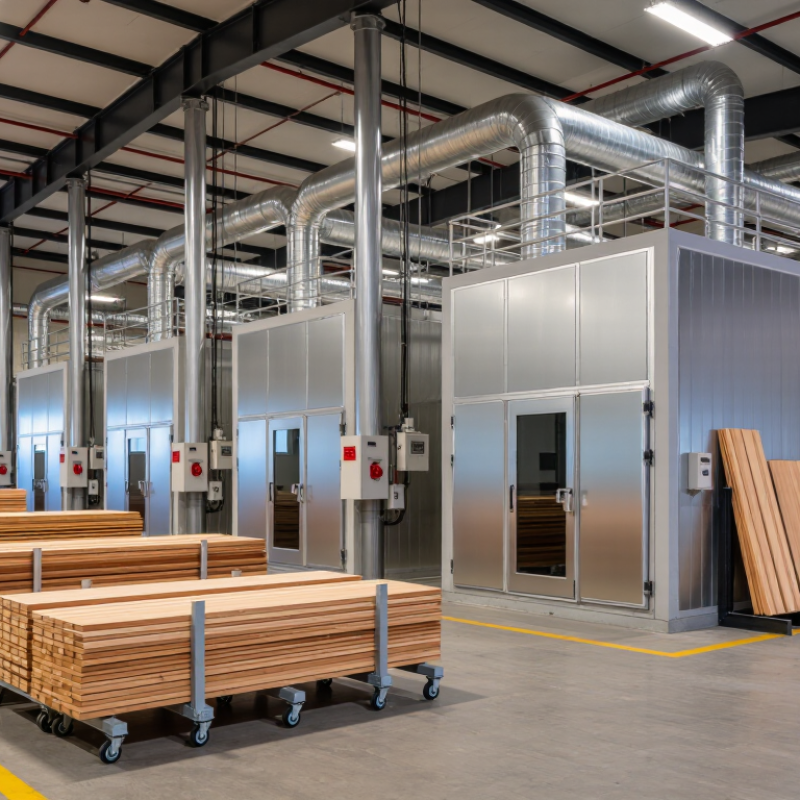
Wood Drying Equipment: Purpose, Process, and Main Technologies
Wood drying removes free and bound water from lumber, improving dimensional stability before machining, assembly, or finishing. The USDA Forest Products Laboratory’s Wood Handbook (FPL-GTR-282, 2021) explains that green wood moisture content varies widely and can exceed 100 percent of oven-dry weight in some species. That variation matters: a thick oak plank and a narrow pine board will not dry at the same pace. Drying too quickly can cause surface checks, internal stresses, or casehardening. The target moisture content should reflect the wood species and its intended service environment.
The process typically involves stacking boards with aligned stickers, controlling airflow and heat, then monitoring moisture until the target is reached. Conventional kilns offer controlled temperature and humidity; dehumidification kilns recover heat, while vacuum systems can shorten cycles for some thick or sensitive stock. Solar drying uses sunlight and ventilation, but weather makes results less predictable. No method is universally best. The U.S. Department of Energy’s Industrial Assessment Center resources identify lumber drying as a significant energy-use area in wood products manufacturing, so insulation, heat recovery, and well-managed schedules can help reduce waste. Still, a faster cycle is not automatically a better one.
Tips: Place a moisture meter’s pins in freshly exposed wood, and check several boards—not just the easiest one to reach. Calibrate readings for species and temperature. Keep a drying log with load thickness, schedule changes, and final readings; small records often reveal recurring defects. Drying schedules need adjustment, and even careful operators sometimes miss uneven airflow.

Wood Drying: Typical Moisture Content Ranges
Wood drying reduces moisture content to suit the intended use. The ranges below are general reference values; suitable targets vary with species, product, and service environment.
Moisture content is expressed as a percentage of oven-dry wood mass. Green wood can exceed 30%; the fiber saturation point is commonly around 28–30%. Indoor-use targets are typically lower than those for outdoor or construction applications.
How Manufacturers Are Evaluated for This Global Overview
A global comparison of wood-drying equipment manufacturers should begin with operating evidence, not brochure claims. We assess kiln temperature control, airflow uniformity, moisture measurement, loading capacity, and documented drying schedules. Small details matter: a sensor placed near a kiln door may not represent conditions deep inside a stack. We also examine commissioning support, operator training, spare-parts access, and how clearly manufacturers explain maintenance needs.
Wood moisture behavior provides a practical benchmark. The USDA Forest Products Laboratory’s Wood Handbook reports equilibrium moisture content of about 6% at 70°F and 30% relative humidity, rising to roughly 11% at 60% relative humidity. These figures show why equipment must control both heat and humidity, rather than temperature alone. They are reference conditions, not guaranteed kiln outcomes; species, board thickness, and airflow change drying results. We look for test records that identify those variables and report final moisture variation across a load.
Energy use and drying time deserve scrutiny, too. A credible evaluation asks for metered consumption per unit of dried lumber, batch records, and evidence of defect rates, such as checking or warping. Independent test data carry more weight than estimated savings. We also consider whether technical support can diagnose uneven drying from actual logs. That can be hard to verify. Some manufacturers publish excellent specifications but limited long-term field data, so rankings should reflect that uncertainty rather than disguise it.
Profiles of 10 Wood Drying Equipment Manufacturers Worldwide
Profiles of ten wood drying equipment manufacturers reveal how differently they solve the same moisture problem.
One specializes in conventional kilns, using insulated chambers and scheduled airflow for sawmills. Another builds heat-pump dryers for smaller workshops seeking lower operating temperatures. A third focuses on vacuum systems, which can dry thick stock under reduced pressure. A fourth makes solar-assisted units suited to regions with strong, dependable sunlight. Results still depend on loading and weather.
A fifth manufacturer designs continuous dryers for high-volume board production. A sixth supplies modular chambers that can be expanded as a business grows. A seventh emphasizes compact equipment for furniture makers with limited floor space. An eighth develops control systems that track temperature and humidity at several points inside a load. A ninth pairs drying chambers with biomass heating, though fuel quality can complicate consistent performance. The tenth serves specialist users drying veneer or other delicate material with close process control.
Small details matter.
When comparing these manufacturers, buyers should ask for chamber capacity, airflow diagrams, energy-use data, and references for similar timber species and board thicknesses. Published cycle times may not match a crowded, unevenly stacked load. A site visit can clarify what a brochure cannot.
Comparing Equipment Types, Capacity, and Key Features
Wood-drying equipment differs in how it handles volume, species, and control. Conventional kilns use heated air and scheduled humidity changes. They suit steady production, but require careful airflow management. Vacuum kilns reduce drying time for thick or valuable stock, though their chambers often limit batch size. Dehumidification kilns recover heat from moist exhaust air and can work well at moderate temperatures. Continuous dryers serve high-throughput mills, but need consistent feedstock. Capacity figures alone can mislead; compare usable load volume, drying time, and daily throughput.
The USDA Forest Products Laboratory’s Wood Handbook explains that lumber drying schedules must account for species, thickness, and initial moisture content. That matters in practice: a stack of thick oak boards cannot be judged by the same cycle as thin pine. The handbook also describes defects such as checking and warping, which can result from uneven moisture loss. A control system should therefore track temperature and humidity at multiple points, not just display one chamber reading. Sensors help. But they need calibration.
Tips: Ask manufacturers for test data using your actual wood species and board dimensions. Check loading access, insulation, fan layout, and service support. Review energy use per unit of dried lumber, not just the advertised cycle time. Small details count. A door seal, for example, can affect both heat loss and drying consistency. I would still request a trial run; specification sheets rarely capture every operating condition.
Factors to Consider When Choosing a Manufacturer
Choosing a wood drying equipment manufacturer starts with the lumber, not the catalogue. Ask whether its kiln design handles your species, board thickness, starting moisture, and target end use. The USDA Forest Products Laboratory’s Wood Handbook (FPL-GTR-282, 2021) shows why control matters: at about 70°F, equilibrium moisture content is roughly 6% at 30% relative humidity and 12% at 65%. A system that cannot hold stable conditions may leave boards unevenly dried. Small differences matter.
Check the manufacturer’s technical evidence. Request drying schedules, sensor accuracy, airflow specifications, and test results from installations using comparable wood. Ask how the system detects wet pockets, manages air leaks, and records temperature and humidity across the load. Look for practical service details, too: spare-part availability, commissioning support, operator training, and response times. Ask for references you can contact. A polished brochure is not a performance record.
Energy use and flexibility deserve close scrutiny. Request measured energy consumption per unit of dried lumber, with the wood species, initial moisture, and operating conditions stated. Compare like with like; otherwise, the figures can mislead. Confirm that the controls allow schedule adjustments as seasons and incoming stock change. This is easy to overlook. I would also ask what happens when a sensor fails mid-cycle. No manufacturer can promise perfect drying, and I would be wary of one that suggests otherwise.
10 Best Wood Drying Equipment Manufacturers Worldwide - Factors to Consider When Choosing a Manufacturer
Technology-based comparison, not a ranked list of named companies. The profiles below describe established equipment categories; actual specifications, performance, and availability vary by supplier, wood species, and operating conditions.
| Manufacturer specialization | Typical equipment | How the drying process works | Common applications | Potential advantages | What to verify when choosing a supplier |
|---|---|---|---|---|---|
| Conventional kiln systems | Batch kilns with fans, heating coils, vents, and humidity controls | Heated air circulates through stacked lumber; temperature and humidity are adjusted according to a drying schedule. | Sawmills, furniture manufacturers, flooring producers, and other facilities drying lumber in batches | Widely used technology; suitable for a broad range of species, thicknesses, and production scales | Usable capacity, airflow uniformity, insulation, heating options, schedule support, and control-system documentation |
| Dehumidification kiln systems | Heat-pump dehumidification kilns, often with circulation fans and supplemental heat | Moisture is removed from circulating air by condensation on a cold coil; recovered heat is used within the kiln. | Small and medium lumber operations, hardwood drying, and facilities seeking controlled batch drying | Can recirculate heat and reduce the need to exhaust heated, moisture-laden air | Operating range, moisture-removal capacity, climate suitability, maintenance requirements, and expected energy use |
| Vacuum kiln systems | Sealed chambers with vacuum pumps, heating plates or other heat-transfer systems, and moisture extraction | Reduced chamber pressure allows water to evaporate at a lower temperature than it would at normal atmospheric pressure. | Thick or valuable lumber and jobs where shorter drying cycles may be beneficial | Lower-temperature drying is possible; some designs can shorten cycles compared with conventional schedules | Chamber dimensions, loading method, vacuum performance, heat-transfer uniformity, service access, and demonstrated results for target stock |
| Radio-frequency vacuum systems | Vacuum chamber equipment using radio-frequency dielectric heating | Radio-frequency energy heats moisture within the wood while vacuum conditions assist moisture removal. | Specialty applications, thicker stock, and production where cycle time or internal heating is a priority | Volumetric heating can support more uniform heat delivery through the load than surface heating alone | Electrical requirements, load configuration, safety systems, process controls, throughput claims, and reference installations |
| Solar kiln systems | Solar-heated kiln chambers, collectors or glazed enclosures, vents, fans, and controls | Solar energy supplies some or most of the heat; ventilation helps carry moisture out of the chamber. | Small sawmills, wood shops, and locations with suitable solar exposure and flexible production schedules | Uses an available renewable heat source and can be designed for relatively simple operation | Local solar conditions, backup heat needs, seasonal capacity, airflow design, insulation, and expected drying time |
| Continuous kiln systems | Progressive or compartment kilns with staged conditions and material-handling systems | Lumber moves through successive zones or compartments where drying conditions change along the process. | High-volume mills processing consistent dimensions and species in regular production flows | Supports steady throughput and can integrate with automated sorting and handling lines | Required throughput, species flexibility, kiln balancing, loading logistics, maintenance access, and control integration |
| High-temperature kiln systems | Kilns engineered for elevated-temperature schedules, with suitable fans, heating, and controls | Higher process temperatures are used under controlled schedules to accelerate drying for suitable products. | Selected softwood and industrial lumber processes where product specifications allow high-temperature drying | Can support faster processing for appropriate species, dimensions, and end uses | Species-specific schedules, strength and appearance requirements, equipment temperature ratings, and quality-control procedures |
| Pre-dryer and conditioning equipment | Pre-dryers, equalizing chambers, and conditioning systems used before or after kiln drying | Pre-drying moderates moisture loss before final kiln schedules; conditioning can help reduce moisture variation and drying stress. | Operations managing green lumber, moisture variation, or quality requirements across a kiln-drying line | Can improve process consistency when correctly matched to the main kiln operation | Target moisture range, airflow, capacity matching, monitoring methods, and compatibility with existing kilns |
| Biomass-integrated kiln systems | Kilns supplied with heat from biomass boilers or integrated combustion and heat-distribution systems | A boiler burns suitable biomass fuel and transfers heat to the kiln, commonly through hot water, steam, or air systems. | Sawmills and wood processors with an appropriate, reliable biomass-fuel supply | Can make use of locally available wood residues as a heat source | Fuel moisture and consistency, emissions compliance, boiler efficiency, ash handling, backup heat, and total installed cost |
| Kiln controls and automation systems | Moisture sensors, temperature and humidity instrumentation, programmable controllers, and monitoring software | Sensors and control logic adjust heating, humidification, ventilation, and fan operation according to selected schedules. | New kiln installations and retrofit projects seeking improved monitoring or repeatability | Can improve process visibility, record keeping, and repeatability when properly installed and calibrated | Sensor calibration, compatibility with existing equipment, data access, remote support, cybersecurity, and operator training |