
Which Submersible Drainage Pump Is Best in 2026?

Choosing the best Submersible Drainage Pump in 2026 starts with the water, not the biggest number on the box. Clear seepage, gritty stormwater, and muddy construction runoff place different demands on an impeller, motor, and seal. A compact basement pit also changes the decision: a bulky pump may fit poorly, while a short cable or awkward float switch can make routine use frustrating. Small details matter. Not just horsepower.

The U.S. Department of Energy’s Improving Pumping System Performance guide estimates that pumping systems consume nearly 20% of global electricity. That figure covers pumping systems broadly, not drainage pumps alone, but it highlights why efficiency deserves attention alongside purchase price. For pump performance comparisons, ISO 9906 provides recognized acceptance-testing procedures; however, a rating does not tell you how a model handles debris in your particular pit. There is no universal winner. This guide compares practical capacity, solids handling, automatic controls, durability, serviceability, and energy use, while noting where specifications can mislead. A pump’s advertised flow may fall when water must travel through a long hose or rise several metres. That is easy to overlook. We also consider installation and maintenance, because even a strong pump can disappoint when its intake clogs or its float catches against a wall. The aim is a useful shortlist, not a perfect answer: the right choice depends on the water, the site, and how often the pump must run.
Which Submersible Drainage Pump Is Best in 2026?

What a Submersible Drainage Pump Is and How It Works

A submersible drainage pump sits beneath the water surface and pushes water through a discharge hose or pipe. Its sealed motor drives an impeller, which moves water toward the outlet. Many models use a float switch: as water rises, the float lifts and starts the pump. When the water level falls, the switch stops it. That sounds simple. It isn’t always. A float can snag against a pit wall, while a blocked intake can reduce flow or overheat the motor.

The best choice in 2026 depends on the job, not a headline number. Check the pump’s flow rate, maximum lift, outlet size, and stated solids-handling capacity. A pump for clear seepage may struggle with leaves or grit. Measure the vertical distance to the discharge point, and allow for losses through long hoses and bends. The label’s maximum flow is not necessarily the flow you will get on site.

Tips: Keep the intake off the bottom, where sediment collects. Test the float in a bucket before installation. Use a properly grounded, protected power supply, and follow the manufacturer’s instructions for wet-area electrical use. Check the hose for kinks. Small details matter, though they are easy to miss. A pump can run and still drain poorly if the outlet is restricted or water flows back after shutdown.


Key Performance Factors for Comparing Pumps in 2026

Which Submersible Drainage Pump Is Best in 2026?

Choosing a submersible drainage pump starts with the water and the job, not the largest number on the box. Compare the pump’s flow rate at the required discharge head; a long hose, narrow pipe, or upward lift can reduce real output. A spec sheet can mislead. Look for a performance curve, then match it to the height and distance water must travel. For a flooded basement, steady removal may matter more than a brief peak-flow figure.

Check the permitted solids size and intended water type. Clear rainwater and gritty construction runoff place different demands on an impeller and housing. A small inlet screen can clog with leaves, while abrasive particles may accelerate wear. Think about duty cycle, too: a pump designed for intermittent use may overheat during hours of continuous operation. That detail is easy to miss.

A reliable comparison also includes automatic controls, thermal overload protection, cable length, and access for cleaning. A float switch should move freely in the pit, without catching on a wall or hose. If the water level varies, test whether the pump starts and stops at useful levels. Consider the awkward part: site conditions are rarely as neat as product descriptions suggest. Confirm electrical suitability and installation requirements with the manual or a qualified installer, especially in damp locations.

Which Submersible Drainage Pump Is Best in 2026? — Key Performance Factors for Comparing Pumps in 2026

There is no single best pump for every job. Compare the pump’s performance at your required operating point, then match its construction and controls to the water and working conditions.

Performance Factor Unit or Check How to Compare Practical Selection Guidance
Flow rate m³/h or L/min Compare the flow shown on the pump curve at the required total dynamic head—not just the pump’s maximum flow figure. Unit conversion: 1 m³/h = 16.7 L/min. Estimate the volume to remove and the time available, then allow for actual site conditions.
Total dynamic head (TDH) Metres (m) Include vertical lift, pipe friction, fittings, and any outlet pressure requirement. Check that the pump curve covers both the required head and flow. Static lift alone is not the full head requirement. Flow generally decreases as the required head increases.
Solids passage Maximum particle size, mm Check the manufacturer’s stated free-passage size and the pump’s intended water type. A screen or impeller design may affect what can pass. Choose for the largest likely debris, not just the average. Stringy material, grit, and fibrous debris may clog a pump even when particles are below its stated passage size.
Water type and impeller Clear, dirty, or solids-bearing water Match the pump design to the fluid: clean-water drainage, general dirty-water drainage, or solids-handling service. For water containing sediment or debris, verify the permitted particle size and whether abrasive solids are acceptable for the pump materials.
Hydraulic power check Watts (W) For water, hydraulic power is approximately 2.73 × flow (m³/h) × head (m), in watts. Electrical input must be higher because pumps are not 100% efficient. Example: 10 m³/h at 10 m head requires about 273 W of hydraulic power. Use the pump’s rated input and performance curve to assess actual energy use.
Power supply Voltage, phase, frequency, current Confirm that the motor’s nameplate ratings match the available supply and that the circuit can handle its running and starting current. Do not assume a pump is compatible based on voltage alone. Check local electrical requirements, plug or wiring arrangement, and protective devices.
Duty rating and thermal protection Continuous or intermittent duty Check the stated duty rating, allowable operating conditions, and whether thermal overload protection is built in. For long or frequent pumping cycles, choose a model rated for that duty. Thermal protection does not make dry running or blocked operation safe.
Automatic operation Float switch or control system Compare start and stop levels, available space for float movement, and compatibility with the intended installation. In a narrow pit, a float may become trapped. Confirm that the pump can start and stop at water levels that suit the site.
Minimum water level and residual water Minimum operating depth or shut-off level Check the specified minimum water level and how much water remains when pumping stops. Drainage pumps do not all pump down to the same level. If a low residual level is important, confirm the stated operating limit for that model.
Materials and wear resistance Wetted materials Check casing, impeller, seals, and fasteners against the water’s chemistry and expected grit or abrasion. Corrosive water and abrasive sediment can shorten service life. Confirm material compatibility rather than relying on appearance alone.
Submersion rating and installation Ingress protection and permitted immersion conditions Read the specified immersion depth, operating limits, cable requirements, and installation instructions. An IPX8 marking indicates protection for immersion under conditions specified by the manufacturer; it does not by itself define unlimited depth or duration.
Best-fit pump type Application match Choose the pump category that meets the water-quality, flow, head, and duty requirements together. Clear water: clean-water drainage pump. Water with moderate debris: dirty-water pump with suitable passage. Larger solids: solids-handling pump with a verified passage size.

Comparison note: Flow, head, solids passage, power, and operating limits vary by model. Use the full pump curve and product specifications for final selection; a maximum-flow rating alone is not enough to identify the best pump.

Pump Types and Their Best Drainage Applications

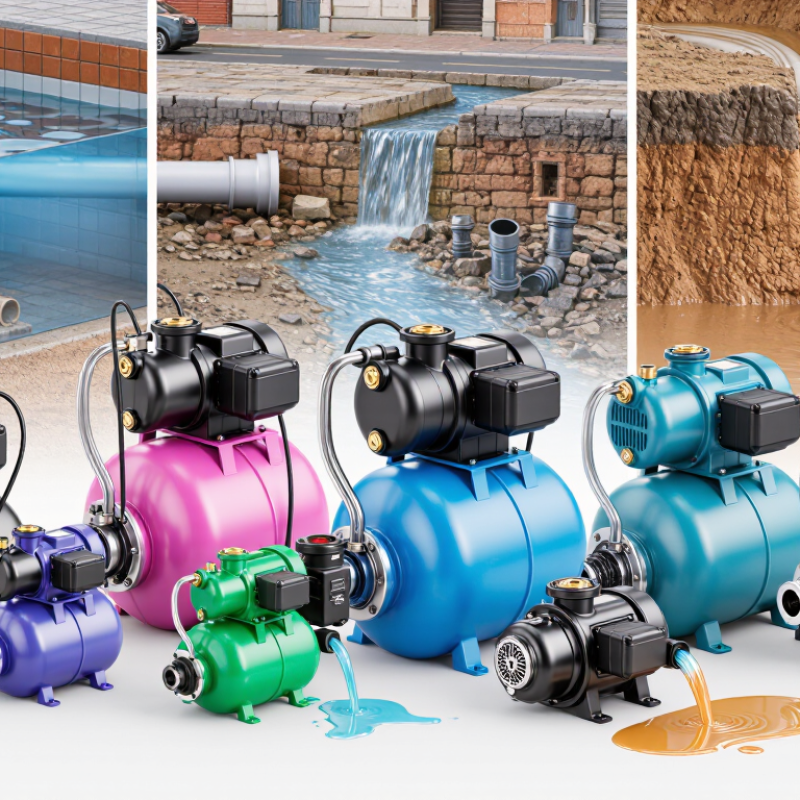
Clear-water submersible pumps suit rainwater, seepage, and relatively clean basements. Their narrow intake screens can clog when leaves or grit enter the pit. For muddy excavation water, choose a dewatering pump rated for abrasive particles. A solids-handling pump is better for wastewater containing soft debris. Check the pump’s maximum solids passage, not just its outlet size.

The U.S. Department of Energy’s Improving Pumping System Performance sourcebook reports that pumping systems use nearly 20% of global electricity demand. It also notes that they can account for 25–50% of energy use in some industrial operations. That makes correct sizing worthwhile: an oversized pump may cycle frequently, while an undersized one may struggle during heavy inflow. There is no single best type. Match flow, lift height, water quality, and expected run time to the site.

Tips: Measure the vertical lift from the water surface to the discharge point. Add hose length and bends to your estimate. Keep the intake clear of settled silt. One detail is easy to overlook: a pump that handles solids may still need regular cleaning.

How to Match Pump Capacity to Site Conditions

A submersible drainage pump should match the site’s peak inflow, not just its floor area. Start with local rainfall intensity from NOAA’s Atlas 14 precipitation-frequency data, then estimate runoff from the contributing surface. For example, 1,000 square metres receiving an illustrative 50 millimetres of rain per hour, with a runoff coefficient of 0.9, could send about 45 cubic metres per hour toward the sump. This is a planning estimate, not a site measurement. Small details matter.

Check the vertical lift, pipe length, bends, and discharge hose diameter; each affects the pump’s delivered flow. Add a margin for uncertainty, but avoid excessive oversizing, which can cause short cycling and needless wear. The U.S. Department of Energy’s Improving Pumping System Performance sourcebook notes that pumping systems use 25–50% of energy at some industrial facilities. That figure is not a drainage-pump benchmark, but it underscores why operating efficiency belongs in the selection. Match solids-handling capacity to actual debris, and confirm the pump can sustain the expected duty cycle. A muddy trench is not a clean test tank. Record water rise during a storm if possible; real site observations may challenge the first estimate.

Which Submersible Drainage Pump Is Best in 2026? — How to Match Pump Capacity to Site Conditions

Illustrative flow estimates for common drainage scenarios. Choose a pump that can deliver the required flow at your actual total dynamic head—not just at the pump’s maximum or zero-head rating.

Suggested capacities include a planning allowance above estimated inflow. Actual requirements vary with rainfall, water source, discharge height, hose length and diameter, and solids. Confirm the pump’s performance curve at the expected operating head; use a solids-handling model where debris is present.

Safety, Maintenance, and Long-Term Operating Costs

A submersible drainage pump earns its keep when it removes water safely and reliably, not merely when its purchase price is low. Keep the plug, cable joint, and control equipment dry, and use a properly protected electrical circuit. Isolate power before lifting or cleaning the pump; never pull it up by its cable. Small mistakes matter.

Maintenance is mostly simple, but easy to postpone. Clear grit and leaves from the inlet, check that the float moves freely, and inspect the discharge hose for kinks. After pumping muddy water, rinse the intake and watch for unusual vibration or a burning smell. Stop if anything seems wrong. A pump that runs dry or cycles repeatedly may wear faster, though the exact risk depends on its design and conditions.

Long-term cost includes electricity, replacement parts, servicing, and damage from a failed pump. The U.S. Department of Energy’s 2006 Improving Pumping System Performance sourcebook estimates that pumping systems use nearly 20% of global electricity; in some industrial facilities, pumping can account for 25–50% of energy use. Those figures cover pumping systems broadly, not drainage pumps alone, but they underline why efficiency deserves attention. Compare expected operating hours and power draw, then consider access for cleaning and repair. I would still leave a little room for uncertainty: real energy use depends on water level, pipe layout, and how often the pump starts.

REQUEST A QUOTE

Menu
[all-fields]