What Are the Best Optical Cable Adapters from China?
Choosing the best Optical Cable Adapters from China takes more than comparing unit prices. The details matter: connector type, polish, alignment sleeve, housing material, and verified insertion loss. A tiny scratch on an end face can disrupt a link. Poor alignment can add loss across every connection. Small parts, real consequences.
The International Telecommunication Union’s Facts and Figures 2024 reports that 5.5 billion people were online in 2024, underscoring the continuing scale of global connectivity. That growth makes dependable fiber infrastructure essential, though it does not prove every adapter supplier is equally reliable. The Fiber Optic Association’s technical guidance stresses inspection, cleaning, and testing at connector interfaces. FOA founder Jim Hayes’s practical field advice can be condensed as: “Inspect, clean, and test.” Buyers should confirm performance data against applicable IEC connector-interface requirements, request test results, and check sample parts under real installation conditions. A polished product photo is not evidence.
This guide compares Chinese suppliers by measurable specifications, material consistency, customization, documentation, and quality control—not marketing claims alone. Some listings look alike. They may not perform alike. There is no universal “best” adapter: a single-mode SC/APC unit for a telecom cabinet may be wrong for a multimode patch panel. Even careful sourcing has limits; batch variation and incomplete reports deserve scrutiny. The aim is practical: identify adapters that fit the network, arrive with traceable test information, and maintain stable optical performance after installation.
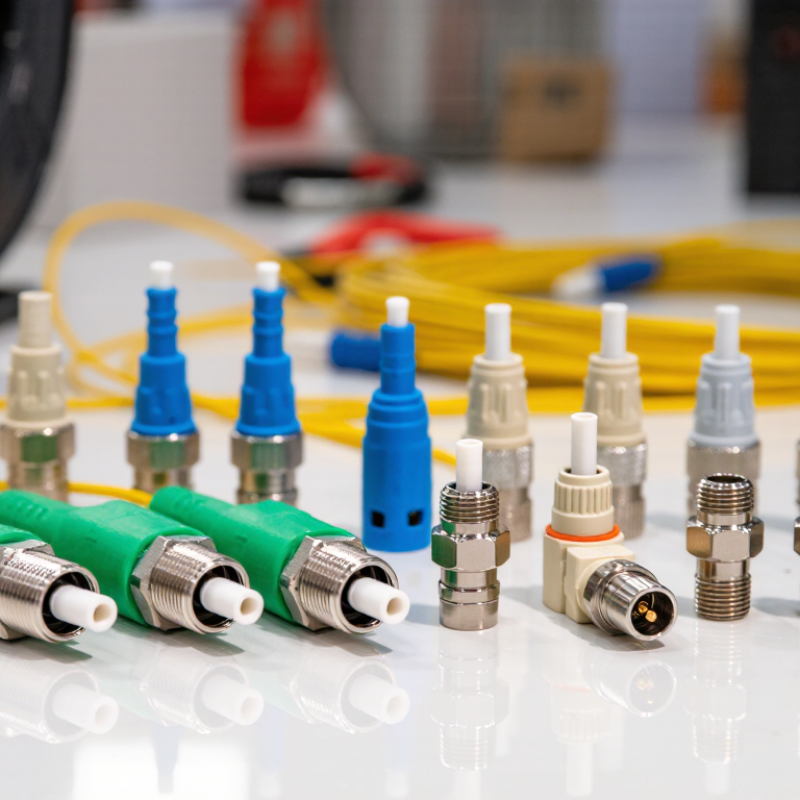
Understanding Optical Cable Adapters and Their Functions
What Are the Best Optical Cable Adapters from China?
Understanding Optical Cable Adapters and Their Functions
An optical cable adapter joins two fiber-optic connectors so light can pass between them. Its sleeve holds the connector tips in line, helping limit signal loss. It does not convert signals or repair damaged fiber. Common connector formats include SC, LC, FC, and ST, with single-mode and multimode options. Choose a format that matches both cable ends and the equipment ports.
Adapter details matter. A ceramic alignment sleeve can provide precise positioning, while the housing protects the connection. Check the specified insertion loss, return loss, polish type, and operating conditions. Duplex adapters connect two fibers; simplex adapters connect one. These details can seem small, but a mismatch may cause weak readings or an unstable link. I still double-check connector polish because it is easy to overlook.
Tips: Keep dust caps on until installation. Inspect and clean both connector end faces with suitable fiber-cleaning tools before mating them. Avoid touching the end faces. If a link performs poorly, test the connectors and cable before replacing the adapter; the adapter may not be the cause.
Common Types of Optical Cable Adapters Made in China
What Are the Best Optical Cable Adapters from China?
Common Types of Optical Cable Adapters Made in China
China-made optical cable adapters commonly use SC, LC, FC, and ST connector formats. SC adapters have a square push-pull housing, while compact LC versions suit high-density panels. FC adapters screw into place, which helps resist movement. ST adapters use a bayonet fitting and remain common in some installed networks. Small parts, different jobs.
Adapters also vary by fiber mode and end-face polish. Single-mode systems often use blue UPC or green APC connections; multimode adapters are commonly beige or aqua. Never match by color alone. Check connector type, polish, fiber mode, and keying against the cable and equipment. A mismatch can raise insertion loss or cause a frustrating link fault. Fit matters more.
Market context helps explain the range of available products, but it does not prove adapter quality. Fortune Business Insights estimated the global fiber-optics market at US$8.79 billion in 2023 and projected US$19.53 billion by 2032. That report covers the broader fiber-optics market, not adapters specifically. For purchasing, request insertion-loss and return-loss test results, plus sleeve material and alignment tolerances. A neat datasheet can still leave questions; verify the sample in the actual panel before ordering at scale.
What Are the Best Optical Cable Adapters from China? – Common Types of Optical Cable Adapters Made in China
| Adapter Type | Connector Interface | Common Configuration | Alignment Feature | Typical Insertion Loss per Mated Pair | Common Applications |
| SC adapter | SC to SC; available for UPC or APC connections | Simplex or duplex | Ceramic alignment sleeve; square push-pull housing | Typically ≤ 0.2 dB for standard-grade models | Telecommunications racks, fiber distribution frames, and FTTH installations |
| LC adapter | LC to LC; available for UPC or APC connections | Simplex or duplex | Ceramic alignment sleeve; compact latch-style interface | Typically ≤ 0.2 dB for standard-grade models | High-density patch panels, switches, and data-center cabling |
| FC adapter | FC to FC; commonly UPC, with APC versions also available | Usually simplex | Ceramic alignment sleeve; threaded coupling interface | Typically ≤ 0.3 dB, depending on grade and mating components | Test equipment, single-mode links, and applications requiring a secure threaded connection |
| ST adapter | ST to ST, generally UPC | Usually simplex | Ceramic alignment sleeve; bayonet-style coupling interface | Typically ≤ 0.3 dB, depending on grade and mating components | Legacy premises networks, campus cabling, and some industrial systems |
| MPO adapter | MPO to MPO; connector type and polish must be matched | Multi-fiber, commonly 12- or 24-fiber formats | Keyed housing; connector alignment pins are part of the mating connector system | Typically ≤ 0.35 dB for standard-grade models; lower-loss grades are available | High-density fiber trunks, data-center links, and parallel-optics systems |
| Hybrid adapter | One connector format to another, such as FC to SC | Usually simplex; configuration depends on the interface pair | Alignment features matched to each connector format | Varies by interface combination; check the specified mated-pair limit | Connecting equipment or patch cords that use different connector formats |
Note: Insertion-loss figures are representative specification targets, not guaranteed values for every adapter. Actual performance depends on the adapter grade, connector condition, fiber type, polish, and measurement method. Confirm interface, polish, fiber count, and test requirements before ordering.
Key Quality and Performance Factors to Compare
When comparing optical cable adapters from China, start with measured loss, not catalog language. TIA-568.3-E commonly allows up to 0.75 dB for a connector connection. Better adapters often target 0.20–0.30 dB insertion loss under controlled testing. Ask for test results at 1310 nm and 1550 nm. Return loss also matters: mated UPC connections commonly reach 50 dB, while APC designs can reach 60 dB. These figures should come from sample testing, not only a supplier datasheet.
Alignment accuracy depends heavily on the sleeve. Zirconia sleeves usually provide more stable centering than metal sleeves, especially after repeated mating. IEC 61754 defines connector interface dimensions, while IEC 61300-3-35 addresses end-face inspection and contamination. A tiny dust particle can create visible attenuation. Cleanliness is not cosmetic. It changes performance.
In field checks, inspect adapters after vibration, temperature cycling, and at least 500 mating operations. Some products remain acceptable on the first test but drift later. That weakness is easy to miss. Compare housing strength, latch fit, polarity marks, and cable strain relief. Request batch-level records, dimensional reports, and independent test evidence. I would also test several random samples, because one perfect sample proves very little. Cheap pricing can reflect efficient production, but it can also hide loose tolerances or inconsistent polishing. Keep that doubt active.
How to Evaluate Chinese Optical Adapter Manufacturers
Choosing the best optical cable adapters from China starts with evaluating the manufacturer, not just the quoted price. Ask whether the factory controls polishing, assembly, and final inspection, or outsources key steps. Request current drawings, connector interface details, and material specifications. A capable supplier should explain its insertion-loss and return-loss test methods, not merely send a polished data sheet. Small details matter.
Review samples using the same connector type, fiber mode, and test setup planned for production. Check end-face inspection records, mating durability data, and packaging that protects ferrules from dust and impact.
Ask about lot traceability and how the manufacturer handles a failed batch. That response may reveal more than a sales presentation. If possible, compare samples from multiple production lots.
This is not foolproof: measurement variation and handling can affect results. Record test conditions and repeat checks; one successful sample cannot guarantee consistent output.
Tips: Send a written checklist. Confirm tolerances, lead time, sample fees, and change-notification practices before ordering. Keep an approved sample as a reference, and inspect incoming adapters under consistent lighting and magnification. Clear communication helps, but verify critical specifications independently.
Choosing an Adapter for Your Fiber-Optic Application
Choosing an optical cable adapter starts with the connectors already installed on your equipment. Match the interface, such as LC, SC, or FC, and confirm whether the ends use UPC or APC polish. These polish types should not be mated together. A mismatch can increase signal loss and make troubleshooting harder.
Fit matters. Check the adapter’s sleeve material, alignment, and stated insertion-loss performance. A ceramic sleeve is common in precision applications, while operating conditions may call for a different housing or mounting style. For a dense rack, a compact duplex adapter can save space. In a dusty workshop, protective caps and easy cleaning matter more. Small details count.
When comparing suppliers in China, request a datasheet, dimensional drawing, and sample before ordering in volume. Check that test results match the connector type and configuration you need. Ask how the supplier controls sleeve alignment and inspects finished units. A low quote can look attractive, but it says little about consistency between batches. I would still verify samples against the actual equipment; specifications alone do not always reveal an awkward fit. The right adapter is the one that meets the application’s optical, mechanical, and installation requirements.