

- 713.590.1312
- sale@pandbtools.com
10 Best Assembly Line Trolleys for Manufacturing
A production line can lose momentum in small ways: a bin arrives late, tools drift from their stations, or an operator makes another trip across the floor. These minutes add up. An Assembly Line Trolley can keep parts, tools, and work-in-progress close to where they are needed, but the right choice depends on the task, route, load, and workspace.
The investment case reflects wider manufacturing priorities. MHI and Deloitte’s 2024 Annual Industry Report found that 55% of surveyed supply-chain leaders planned to increase technology investment. Deloitte’s 2024 Smart Manufacturing Survey also reported that 86% of manufacturing executives viewed smart manufacturing as a potential source of competitive advantage within five years. These findings do not prove that a trolley alone improves performance. They do show why manufacturers are reviewing the movement of materials alongside broader process improvements.
Details matter. A narrow aisle may favor a compact footprint, while heavy components call for suitable load capacity, stable wheels, and secure shelves. Smooth floors are different from uneven ones. Handle height, braking, and cleaning access can affect daily use, too. Small choices.
This guide compares 10 assembly line trolleys for manufacturing, with attention to practical features and likely applications. No single model suits every line. Product specifications should be checked against real loads and routes, and even a well-designed trolley may need adjustment after operators test it. The best fit is the one that supports a safer, clearer workflow without adding unnecessary steps.
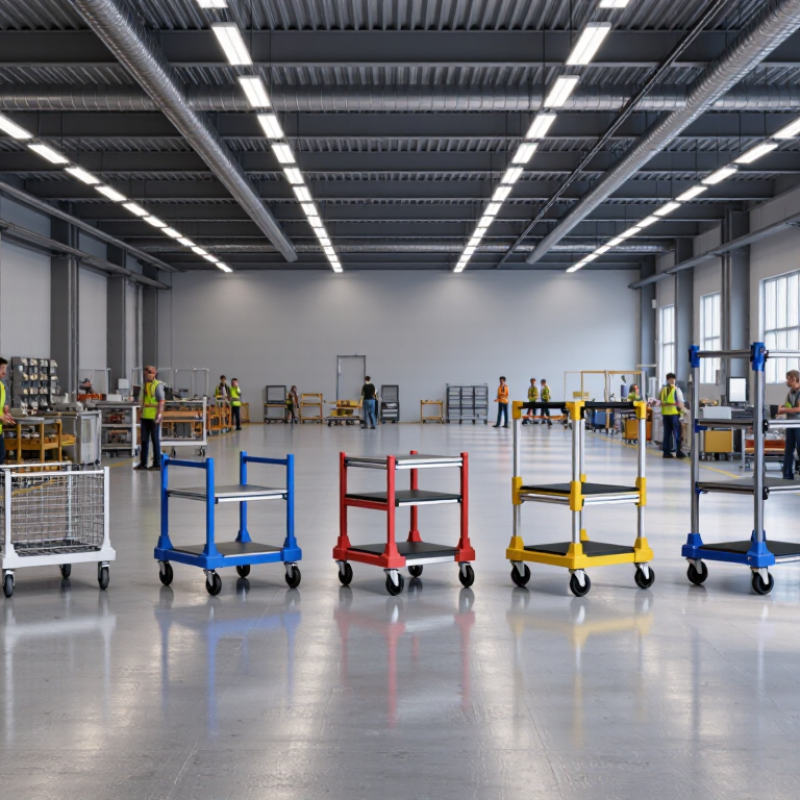
Understanding the Role of Assembly Line Trolleys in Manufacturing
Assembly-line trolleys connect workstations by carrying parts, tools, and small batches along a defined route. A stocked trolley can bring fasteners and components within easy reach, reducing repeated trips to a central store. It also helps teams keep parts in sequence. That matters.
The U.S. Bureau of Labor Statistics reported 2.8 recordable injury and illness cases per 100 full-time-equivalent workers in manufacturing in 2023, compared with 2.4 across private industry. These figures describe recorded cases; they do not show that trolleys prevent injuries. OSHA materials-handling guidance emphasizes assessing load weight, travel paths, and pushing or pulling demands. A trolley’s wheel size, handle height, brakes, and shelf layout therefore matter as much as its capacity. It is easy to overlook.
A poorly matched trolley can cause awkward reaches, blocked aisles, or difficult turns at a workstation. Check the route with a loaded cart, not an empty one. Include operators in the trial: they often notice snags that a floor plan misses. A trolley is not a cure-all. Poor stocking habits and uneven floors can still disrupt flow, so review the setup after production changes.

Key Types and Features of Assembly Line Trolleys
Assembly line trolley types should match the movement they support. Shelf carts carry parts between workstations, while kitting carts organize components for a specific build. Platform trolleys handle bulky loads; FIFO carts keep replenishment moving along a defined route. MHI’s 2024 Annual Industry Report drew responses from over 1,000 supply-chain professionals. It reported that 55% planned to increase investment in supply-chain innovation within two years. That points to growing attention on material flow, though it does not mean every line needs a specialized cart.
Look closely at load capacity, shelf spacing, wheel type, and turning radius. Swivel casters help in tight cells; fixed wheels can track more steadily along straight aisles. Brakes help prevent drift during loading.
Small details matter. Rounded handles, a comfortable push height, and clear sightlines can make repeated trips less awkward. For mixed-size parts, adjustable bins and removable dividers reduce searching, but they can rattle if poorly secured.
Match construction to the floor and the product: conductive wheels may suit electrostatic-sensitive areas, while corrosion-resistant finishes help in damp cleaning zones. Check the cart fully loaded, not empty; wheel resistance and stopping behavior change with weight. A trolley that works in a quiet trial may feel cumbersome during a crowded shift. That trade-off matters. A perfectly fitted cart can still become a nuisance when the product mix changes, so leave room for adjustment and reassess after operators use it.
How Trolleys Improve Material Flow and Workplace Efficiency
Assembly-line trolleys keep parts close to the point of use. Operators can move fasteners, tools, and components in one planned trip instead of making repeated walks to distant shelves. A trolley with labeled bins also makes shortages visible before a station runs dry. Small gains matter. On a busy line, fewer interruptions can help maintain a steadier pace between workstations.
The U.S. Bureau of Labor Statistics reported 2.6 million nonfatal workplace injury and illness cases in private industry in 2023. That figure is not specific to trolley use, but it highlights why reducing unnecessary carrying deserves attention. Choose a trolley that fits aisle widths, carries the actual load, and has brakes for safe parking. Keep heavier items low, and test turning space with a loaded cart. A trolley can also become an obstruction if routes are narrow or parking spots are unclear. That part is easy to overlook. Review the setup with operators; their daily experience often reveals awkward reaches and detours that a floor plan misses.
Ten Assembly Line Trolleys for Different Manufacturing Needs
Assembly lines need different trolley designs, not one universal solution. A kit-picking trolley keeps parts for a single order together. An open-shelf trolley suits frequent access to cartons and tools. A bin trolley separates small fasteners by task. A flat-platform trolley carries bulky items that do not fit neatly on shelves. A height-adjustable lift trolley brings components closer to a comfortable working level. Small details matter.
For longer routes, a towable trolley can move several loads in one trip, if aisle space and turning points allow. A FIFO flow-rack trolley presents parts in sequence and helps replenish stock from the rear. An enclosed trolley protects sensitive supplies from dust and accidental knocks. A mobile workstation carries tools, instructions, and a small work surface between stations. A heavy-duty trolley supports larger components, but its rated capacity must match the actual load. One compromise: enclosed sides improve protection but slow access. Measure doorways, aisle widths, and storage locations before choosing.
Tips: Check wheel material against the floor, and test turning with a realistic load. Locking casters can steady a trolley during loading. Keep handles within easy reach, and inspect wheels for wear. A trolley that looks efficient when empty may feel awkward on a crowded shift.
10 Best Assembly Line Trolleys for Manufacturing — Ten Assembly Line Trolleys for Different Manufacturing Needs
| Trolley Type | Best Suited For | Typical Construction | Typical Load Capacity | Common Configuration | Key Selection Consideration |
|---|---|---|---|---|---|
| Multi-shelf assembly trolley | Moving components, tools, and work-in-progress between nearby workstations | Steel frame with steel or polymer shelves | About 150–500 kg total | Two to four shelves; fixed or adjustable shelf spacing | Check the safe working load per shelf as well as the trolley’s total capacity. |
| Picking and kitting trolley | Delivering grouped parts to an assembly operator in a planned sequence | Steel or aluminum frame with bins, trays, or divided shelves | About 100–300 kg total | Multiple small-part bins, label positions, and compartmented trays | Choose bin sizes and layout to match the parts and picking sequence. |
| Heavy-duty platform trolley | Transporting bulky assemblies, tooling, or packed goods | Welded steel frame with a steel or non-slip deck | About 300–1,000 kg | Flat platform, often with a push handle; optional side rails | Confirm floor condition, ramp gradients, and load stability before selecting capacity. |
| Enclosed cabinet trolley | Keeping tools, instruments, or valuable components contained during internal transport | Steel cabinet body with lockable doors and a wheeled base | About 100–300 kg total | Lockable compartments, shelves, and optional drawers | Account for the cabinet’s own weight and verify that doors stay secure while moving. |
| Tool trolley | Bringing hand tools and maintenance supplies to assembly or service stations | Steel or aluminum frame with drawers and a worktop | About 100–300 kg total | Several drawers, a top tray, and often a locking mechanism | Look for drawer retention and a stable layout that limits tipping when drawers are open. |
| Roll-cage trolley | Moving cartons, reusable containers, or light-to-medium goods through production areas | Steel base with mesh or tubular sides | About 250–500 kg | Three or four sides, sometimes with a hinged access side | Check the internal dimensions, access opening, and suitability for the facility’s aisles. |
| ESD-safe trolley | Handling electrostatic-sensitive electronic parts and assemblies | Conductive or static-dissipative materials with compatible wheels | About 100–300 kg total | Shelves or bins with provisions for grounding where required | Verify electrical resistance and grounding arrangements against the site’s ESD control program. |
| Stainless-steel trolley | Production spaces that require frequent washdown or corrosion-resistant equipment | Stainless-steel frame and shelves | About 100–300 kg total | Two or three shelves, with smooth or raised-edge surfaces | Match the steel grade, weld finish, and wheel materials to cleaning chemicals and hygiene needs. |
| Ergonomic height-adjustable trolley | Bringing workpieces or tools to a more suitable handling height | Steel frame with a manual or powered lift mechanism | About 100–500 kg, depending on the lift design | Adjustable platform or shelf with a defined lift range | Check the rated load throughout the lift range and use the trolley according to its operating instructions. |
| Towable line-side trolley | Scheduled delivery of components along a production route | Reinforced steel frame with tow hitch and industrial wheels | About 300–1,000 kg, depending on design and train setup | Flat deck, shelves, or bins; some designs can be linked into a train | Confirm hitch compatibility, turning clearance, braking needs, and the approved towing load. |
Capacity figures are indicative ranges for common industrial designs, not specifications for a particular trolley. Actual safe working loads vary by model, wheel arrangement, floor conditions, and load distribution; always follow the manufacturer’s rating and facility safety procedures.
How to Choose and Maintain the Right Assembly Line Trolley
Choose an assembly line trolley around the work, not just the available floor space. Measure aisle width, turning points, workstation height, and the largest load. Check wheel material against floor condition; small hard wheels can rattle over joints, while soft wheels may resist rolling. Test the loaded trolley through a real production route. A smooth empty-cart test proves little.
NIOSH’s 1994 Revised Lifting Equation sets a 51-pound load constant only for ideal lifting conditions; reach, height, twisting, and repetition reduce the recommended limit. This is not a trolley capacity rating. It is a useful reminder to assess how workers load and unload each cart, and to trial pushing effort separately. No single model fits every station.
For maintenance, inspect wheels, brakes, handles, welds, and fasteners on a fixed schedule. Remove debris from casters and replace worn parts before wobble becomes a daily nuisance. Keep a simple log of defects and repairs. A brief squeak can be an early warning, though not always. Record recurring problems, then reconsider the route, load, or trolley design.