
2026 Best Humidor Box for Wholesale Buyers?

Choosing the right Humidor Box for wholesale distribution in 2026 requires more than comparing prices. Buyers must examine humidity stability, material quality, capacity, packaging, and supplier consistency. A polished exterior can hide weak seals or uneven interior finishing.

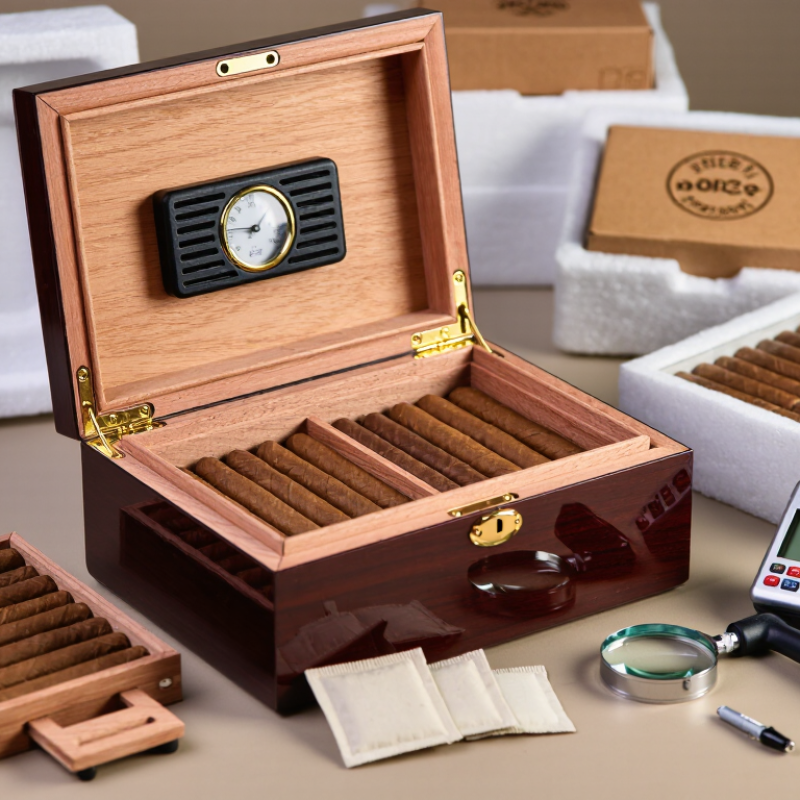
In practical testing, a reliable humidor should maintain a steady environment across changing room conditions. Spanish cedar lining, accurate hygrometer placement, and a well-fitted lid deserve close attention. Check the corners, hinges, tray movement, and odor before approving a large order. Small defects become expensive when multiplied across hundreds of units.

Wholesale buyers should also request product samples, inspection records, moisture-control instructions, and clear replacement terms. Experienced suppliers can explain seasoning procedures without vague promises. They should provide repeatable specifications for wood thickness, hardware, coatings, and carton protection. Supplier communication matters. Delayed answers may signal future problems.

Costs still matter. However, the cheapest Humidor Box may create higher return rates, damaged inventory, or customer complaints. A better evaluation compares landed cost, durability, defect allowance, and delivery reliability. No box is perfect. Even strong designs may need adjustments for climate, retail display, or regional shipping conditions.

This guide reviews practical options for wholesale buyers seeking dependable performance in 2026. It considers evidence from product construction, supplier documentation, and realistic handling conditions. Some recommendations remain judgment calls, especially when appearance competes with long-term stability. Buyers should verify every claim before committing to a full purchase.
2026 Best Humidor Box for Wholesale Buyers?

What Defines the Best Humidor Box for Wholesale Buyers in 2026

2026 Best Humidor Box for Wholesale Buyers?

What Defines the Best Humidor Box for Wholesale Buyers in 2026

The best humidor box must protect inventory during storage and transport. Appearance alone is not enough. Buyers should inspect humidity stability, seal quality, wood construction, and measurement accuracy. The USDA Forest Products Laboratory’s Wood Handbook (2021) explains that wood exchanges moisture with surrounding air. Poorly dried wood may warp, crack, or weaken the seal. In practical inspections, a stable interior often matters more than decorative finishing.

Humidity control deserves measurable proof. The ASHRAE Handbook—Fundamentals identifies 30–60% relative humidity as a common indoor comfort range. A humidor requires a more controlled environment than that. Wholesale buyers should request test records showing narrow humidity variation, sensor calibration, and recovery after opening. ISTA 3A packaging testing can also help evaluate vibration, drops, and transport stress. These tests are useful, but they do not replace product-specific inspection. A report can look perfect. Real cartons may still arrive damaged.

Tips: Check seals, corners, and hinges first. Ask for wood moisture data and calibration dates. Choose replaceable humidity components. Avoid unclear capacity claims. A simple spreadsheet can track sample results across suppliers. It may reveal inconsistencies. That weakness is worth discussing before a large order. Avaliable colors and custom packaging matter, but dependable humidity performance should decide the purchase.


Key Humidor Box Types and Their Wholesale Applications

2026 Best Humidor Box for Wholesale Buyers?

Key Humidor Box Types and Their Wholesale Applications

Wholesale buyers should match humidor construction with the selling environment. Desktop boxes suit specialty retailers and gift departments. They usually hold 20 to 100 cigars and need stable seals, removable trays, and accurate humidity control. Cabinet humidors serve hospitality venues and premium retail counters. Their larger capacity demands stronger hinges, adjustable shelves, and reliable monitoring. A poor seal can damage inventory quickly.

Travel humidors target mobile customers and corporate gifting programs. Their compact cases need shock resistance, secure latches, and foam that prevents movement. Modular humidors work well for retailers testing smaller assortments. They also reduce initial inventory risk. Electronic humidors offer tighter climate control, but batteries and sensors increase after-sales demands. That trade-off deserves attention.

Euromonitor International’s Tobacco 2024 industry analysis identifies premium products as a value-focused segment, despite changing consumption patterns. This supports better presentation and storage, not uncontrolled volume. Smithers’ 2024 global packaging outlook also highlights traceability, material efficiency, and durable packaging as purchasing priorities. Buyers should request wood-source documentation, humidity-test records, and carton compression data. FSC-certified wood may strengthen procurement reviews, but certification alone does not prove performance. I would test every shipment in real warehouse conditions. Reported specifications can look perfect. Factory results are not always retail results.

How to Evaluate Capacity, Materials, and Humidity Control

2026 Best Humidor Box for Wholesale Buyers?

Wholesale buyers should evaluate usable capacity, not the headline count. A box packed to its limit restricts airflow and makes humidity uneven. Leave about 20% free space for circulation and inspection. Measure the internal length, width, and height. Then compare those figures with the supplier’s stated capacity. This small step often exposes optimistic packaging claims.

Material choice affects stability and appearance. The USDA Forest Products Laboratory’s Wood Handbook explains that wood exchanges moisture with surrounding air. Rapid environmental changes can therefore cause movement, gaps, or warped panels. Cedar lining is commonly selected for its aroma and moisture-buffering behavior, but its thickness and sealing quality matter more than its name alone. Check hinge alignment, gasket compression, tray fit, and the absence of visible cracks. A beautiful finish cannot correct poor construction.

Tips: Request independent hygrometer calibration data and a 30-day stability record. ASHRAE’s Handbook—Fundamentals identifies 40%–60% relative humidity as a common indoor comfort range, but humidor systems require a narrower, product-specific target. Ask suppliers to document their recommended range and testing temperature. Digital readings can drift. Test several units before placing a large order, especially after shipping through dry or cold regions. My practical mistake was trusting one sensor reading; repeated measurements revealed uneven humidity near the lid.

2026 Best Humidor Box for Wholesale Buyers? How to Evaluate Capacity, Materials, and Humidity Control

A practical comparison of common humidor capacity bands and established cigar-storage humidity targets. Capacity is expressed as approximate cigar count, while humidity values represent commonly used storage ranges rather than brand-specific specifications.

For wholesale evaluation, confirm that the stated capacity leaves airflow around the cigars, check whether the interior uses Spanish cedar or another stable lining material, and verify that the humidification system can maintain a consistent relative humidity level. A 65–72% RH range is widely used for premium cigar storage, with the final target depending on cigar format and user preference.

Essential Features for Quality, Compliance, and Brand Customization

2026 Best Humidor Box for Wholesale Buyers?

A quality humidor box needs stable humidity, clean construction, and repeatable factory control. Cedar lining should fit tightly, without loose fibers or strong chemical odors. A calibrated hygrometer helps, but it is not enough. Buyers should request humidity test records from several production batches. Practical target ranges often sit near 65–72% relative humidity, depending on the stored product and regional conditions.

Compliance begins with documentation. Ask for material declarations, product safety testing, and country-specific labeling guidance. ISO 9001:2015-based quality systems can improve traceability, although certification alone does not guarantee good workmanship. The U.S. Census Bureau reported that e-commerce represented 16.1% of 2024 retail sales. Therefore, reinforced corners, barcode space, and drop-test evidence matter more than before. Small failures become expensive returns.

Customization should remain functional. A recessed logo, laser engraving, or private-color finish can strengthen shelf identity without weakening the lid seal. Avoid unverified environmental claims. FSC-certified wood may support responsible sourcing, but buyers must check certificate scope and supplier validity. In wholesale audits, packaging samples sometimes look excellent while production tolerances drift. That weakness deserves attention. Require approved samples, measurable tolerances, carton specifications, and pre-shipment inspection photographs. A beautiful box is not automatically a reliable box. Source references: U.S. Census Bureau, Annual Retail Trade Survey, 2024; ISO 9001:2015 quality-management guidance; Forest Stewardship Council certification requirements.

2026 Best Humidor Box for Wholesale Buyers? - Essential Features for Quality, Compliance, and Brand Customization
Evaluation Dimension Wholesale-Ready Benchmark Preferred Specification Buyer Verification Method Compliance or Commercial Relevance Customization Opportunities
Storage Capacity Common commercial sizes range from 25 to 150 cigars, depending on interior layout and cigar ring gauge. Offer at least three capacity options, such as 25, 50, and 100 cigars, to cover different retail price points. Check the internal dimensions and test the box with the intended cigar sizes, including Churchill and Toro formats. Capacity affects carton dimensions, freight cost, shelf placement, and product positioning. Removable traysDivider layoutAccessory compartment
Interior Wood Spanish cedar is widely used because it supports aroma protection, moisture buffering, and resistance to common tobacco pests. Use kiln-dried, odor-controlled cedar with consistent thickness and smooth, splinter-free surfaces. Request wood species confirmation, thickness records, moisture data, and a physical sample before bulk production. Wood species and treatment records help support material traceability and reduce odor or contamination risks. Cedar liningWood stainLaser engraving
Humidity Operating Range A practical cigar-storage target is generally 65%–72% relative humidity, depending on cigar type and user preference. Design the box for stable humidity retention rather than claiming one universal humidity level. Conduct a sealed-box test with a calibrated hygrometer under controlled room conditions for at least 48 hours. Clear humidity guidance reduces misuse, customer complaints, and product-return risk. Humidity guideDigital hygrometerHumidifier tray
Hygrometer Accuracy For consumer humidors, a practical target is approximately ±2% to ±3% RH within the specified operating range. Use a calibrated digital unit with replaceable batteries and a clearly stated measurement range. Compare readings against a reference instrument or perform a salt-test verification before shipment. Accurate readings help prevent over-humidification, mold growth, wrapper damage, and customer dissatisfaction. Dial gaugeLCD displayBranded dial face
Seal and Lid Fit The lid should close evenly around the full perimeter with no visible gaps, twisting, or loose hinges. Use a continuous compression seal or precisely fitted wood-to-wood closure with stable hinge alignment. Perform a paper-strip test around the lid and inspect the seal after repeated opening and closing cycles. A reliable seal is essential for humidity retention and long-term product performance. Magnetic closureBrass hardwareSoft gasket
Seasoning Requirement New wooden humidors commonly require approximately 7–14 days of conditioning before regular use. Supply a written seasoning procedure and specify whether the unit is shipped dry, pre-conditioned, or ready to use. Review the instruction sheet and test moisture stability after conditioning according to the stated procedure. Correct instructions reduce warranty claims caused by cracked wood, unstable humidity, or incorrect setup. Printed guideQR instructionsPre-seasoning service
Wood Moisture Control Wood should be properly kiln-dried and free from excessive residual moisture, surface mold, and strong chemical odor. Set a documented incoming-material moisture specification appropriate for the selected wood and production environment. Use a calibrated wood moisture meter and maintain batch inspection records. Moisture control supports dimensional stability, reduces warping, and improves consistency between batches. Material certificateBatch codingInspection report
Finish and Coating The exterior finish should be even, cured, scratch-resistant, and free from sticky surfaces, peeling, or strong residual odor. Use a coating system suitable for consumer wood products and keep the interior free from unsuitable finishes. Inspect gloss consistency, adhesion, odor, cure time, and surface defects on production samples. Coating selection can affect chemical safety, odor transfer, appearance, and import documentation. Matte finishGloss finishNatural wood finish
Packaging Protection Packaging should protect corners, hinges, glass, and finished surfaces during stacking and international transport. Use a fitted protective insert, moisture-resistant outer carton, and drop-tested packaging configuration. Review carton dimensions, compression strength, drop-test results, and packing photographs. Improved packaging reduces transit damage, replacement costs, and retail presentation issues. Custom insertGift boxRetail sleeve
Product Safety Documentation Documentation should identify materials, coatings, hardware, packaging, and any included electronic components. Maintain a technical file containing specifications, inspection records, test reports, and user instructions. Request documents before purchase order approval and confirm that they match the final production configuration. Requirements vary by destination and product configuration; documentation supports customs and market compliance reviews. Technical fileMaterial declarationUser manual
Brand Customization Common methods include laser engraving, screen printing, metal plaques, printed packaging, and custom color matching. Use a documented approval process for artwork, color, placement, dimensions, and production samples. Approve a pre-production sample or digital proof before mass production. Clear artwork control prevents costly rework and protects consistency across retail channels. Logo engravingMetal badgeCustom carton
Quality-Control Plan Inspection should cover dimensions, wood defects, finish, hardware, seal, humidity accessories, packaging, and labeling. Use first-article approval, in-process inspection, and final random inspection based on an agreed sampling plan. Require a written checklist, defect photos, sample size, acceptance criteria, and corrective-action records. Documented quality control improves batch consistency and provides evidence when resolving claims. Inspection checklistPhoto reportAQL-based inspection
Commercial Selection Score Recommended evaluation weighting: 30% humidity performance, 25% construction, 20% finish, 15% documentation, and 10% customization. Prioritize functional stability before appearance or low purchase price. Score each supplier sample using the same weighted checklist and record pass/fail results. A weighted method helps wholesale buyers compare products objectively across different quotations. Buyer scorecardSample comparisonSupplier audit
Wholesale buying note: The specifications above are practical purchasing benchmarks rather than universal legal limits. Final requirements should be confirmed against the destination market, selected materials, packaging configuration, and any electronic accessories included with the humidor.

How to Compare Suppliers, Pricing, and Order Requirements

For wholesale buyers, the best humidor box is not simply the cheapest wooden case. Supplier comparison starts with repeatable quality. Request one production sample before discussing large quantities. Check the seal, hinge alignment, tray fit, and interior finish by hand. Spanish cedar should feel dry, clean, and evenly fitted. A reliable supplier can explain wood sourcing, moisture control, packaging, and inspection procedures. Photographs can mislead.

Pricing should show more than a unit figure. Ask for tiered prices at different order volumes, including sample, 100-unit, and 500-unit quantities. Confirm whether printing, custom engraving, inserts, and protective cartons are included. Calculate the landed cost with freight, duties, insurance, and handling fees. A low factory quote may become expensive after delivery. It happens often. Request a written quotation with currency, validity period, payment terms, and defect replacement rules.

Order requirements deserve equal attention. Confirm the minimum order quantity, production lead time, carton dimensions, and available customization limits. Ask how the supplier handles color variation, warped panels, damaged hinges, and late shipments. A pre-shipment inspection can verify dimensions, finish, odor, and packaging strength. Keep approved samples and written specifications together. That protects both sides during repeat orders. One weakness remains: even careful forecasts can miss seasonal demand. A smaller pilot order may reduce risk, although its unit price will usually be higher.

Article Source:

REQUEST A QUOTE

Menu
[all-fields]